


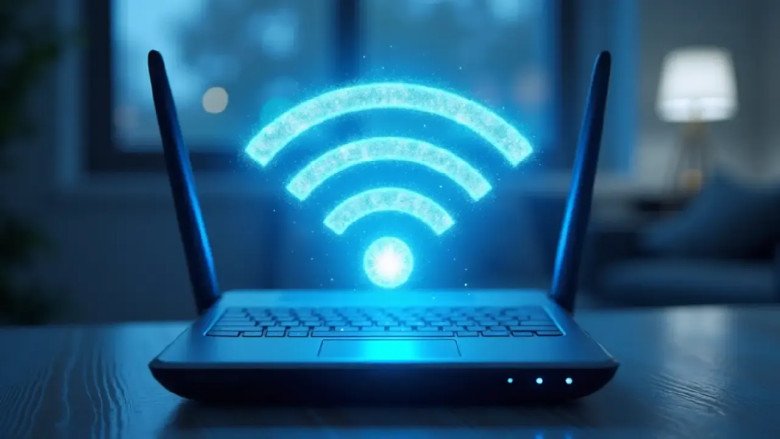
Let’s be honest: are you tired of the 'Future of Wireless' only delivering incremental improvements? We’ve all been there—trying to stream 4K video while a family member is on a video call, only to have the network groan and stutter. That experience is why Wi-Fi 7 is not just another update; it’s a technological earthquake.
Officially known as IEEE 802.11be and designated as Extremely High Throughput (EHT), Wi-Fi 7 is the generational leap that finally promises to kill wireless latency and bottlenecks for good. With theoretical peak speeds soaring up to an astonishing 46 Gigabits per second (Gbps)—a massive jump of over four times the speed of Wi-Fi 6—this standard is built to handle things that don’t even exist yet, like truly collaborative, high-fidelity Metaverse experiences and uncompressed 8K video streaming.
The magic lies in three revolutionary features: Multi-Link Operation (MLO), the monstrous 320 MHz channel width, and the data-packing efficiency of 4K-QAM. Get ready to explore the foundational shift that will govern every aspect of our digital lives, making today’s fastest Wi-Fi look like a dial-up connection.
The Three Pillars of Wi-Fi 7: Speed, Capacity, and Reliability
Wi-Fi 7's mandate was clear: solve the problem of network congestion and provide a wired-like experience wirelessly. It achieves this by not just pushing higher maximum speeds, but by completely rethinking how devices communicate with the router across the 2.4 GHz, 5 GHz, and the spacious 6 GHz bands.
The term Extremely High Throughput (EHT) isn't marketing fluff; it signifies a massive jump in both data rate and network efficiency, especially in crowded environments like apartment buildings or busy offices. The magic happens when its core technologies work together, creating a network that’s not just faster, but genuinely smarter and more adaptable.
1. MLO: The Multi-Lane, Self-Healing Wireless Superhighway
If there is one feature that defines the Wi-Fi 7 generation, it is Multi-Link Operation (MLO). In the past, your device was stuck using a single frequency band—you were either on the 2.4 GHz lane, the 5 GHz lane, or, more recently, the 6 GHz lane. If that single lane got jammed with traffic (interference or congestion), your connection would slow down or drop completely. MLO shatters this limitation.
MLO allows your device to simultaneously connect and transmit data across two or more frequency bands (e.g., 5 GHz and 6 GHz). Think of it like a smart driver who can use two highways at once. The benefits are dramatic and immediate:
-
- Aggregated Speed: Your device effectively combines the bandwidth of the links, achieving unprecedented throughput levels for ultra-fast downloads and massive file transfers. This is how Wi-Fi 7 hits those multi-gigabit speeds.
- Reliability and Failover: The connection can use one link as a primary path and the other as a continuous backup. If the primary link suddenly encounters noise, the traffic instantly and seamlessly shifts to the secondary link, resulting in virtually zero latency spikes or dropped connections. For a video conference or competitive online game, this is a literal lifesaver.
- Lower Latency: The data can be duplicated and sent across both links, with the receiver only needing to wait for the first successful packet to arrive. This technique is key to achieving a claimed 4x reduction in latency compared to Wi-Fi 6E, making real-time applications feel instant.
2. 320 MHz Channel Width: Doubling Your Data Pipe
If MLO is the concept of a multi-lane highway, the 320 MHz channel width is the actual physical expansion of those lanes. While Wi-Fi 6E introduced the 6 GHz band, it was limited to a maximum channel width of 160 MHz. Wi-Fi 7 doubles this, providing a 320 MHz channel primarily within the pristine, less-congested 6 GHz spectrum.
Think of channel width as a pipe transporting water: a 320 MHz pipe can move twice as much data in the same amount of time as a 160 MHz pipe. This massive increase in bandwidth is fundamental to achieving the peak speeds promised by Wi-Fi 7. Crucially, the standard also incorporates a feature called Preamble Puncturing.
In congested areas, if a small part of that 320 MHz pipe is blocked by interference, older standards would have to abandon the entire pipe. Preamble Puncturing allows the Wi-Fi 7 router to selectively block (or "puncture") only the interfered segment, still utilizing the rest of the 320 MHz width, thus preserving high throughput even in challenging environments. This is peak spectral efficiency.
3. 4096-QAM (4K-QAM): The Ultimate Data Compression Trick
Data modulation schemes determine how much information can be encoded into a single wireless signal. Wi-Fi 6 used 1024-QAM, which was impressive. Wi-Fi 7 takes this concept to the extreme by introducing 4096-QAM (4K-QAM). To put it simply, 4K-QAM is like upgrading the shipping container (the signal) to pack more boxes (data bits) inside without making the container bigger.
By increasing the constellation size, 4K-QAM allows each symbol to carry 12 bits of data (up from 10 bits in 1024-QAM). This feature alone provides a 20% increase in the maximum theoretical transmission rate within the same bandwidth. While 4K-QAM requires an extremely clean, strong signal to work flawlessly—meaning it’s most effective when the device is close to the router—it is a critical factor in pushing Wi-Fi 7 past its predecessors and contributing significantly to the extremely high throughput designation.
Why Wi-Fi 7 is a True Game Changer, Not Just Wi-Fi 6E Plus
Let’s cut through the confusion right away. Many people mistakenly view Wi-Fi 7 (802.11be) as a simple, incremental speed bump over Wi-Fi 6E (802.11ax). But this couldn't be further from the truth. While Wi-Fi 6E’s great legacy was the gift of the uncrowded 6 GHz band, Wi-Fi 7's genius lies in a fundamental architectural overhaul: it redefines how data is moved. Wi-Fi 6E was built on a "single-link, single-lane" philosophy, meaning your device was constrained to one frequency band at a time. Wi-Fi 7, on the other hand, is a complete, dynamic transportation network designed for superior efficiency, making it the essential upgrade for the modern, multi-device home and enterprise.
The most striking difference is the raw potential it unlocks. The maximum theoretical speed vaults from a respectable 9.6 Gigabits per second (Gbps) on Wi-Fi 6E to an astonishing 46 Gbps on Wi-Fi 7, marking a near 4.8x increase in throughput capacity. This massive leap is structurally supported by two main factors.
Firstly, the physical bandwidth: Wi-Fi 6E was limited to 160 MHz channel width, but Wi-Fi 7 doubles this capacity with ultra-wide 320 MHz channels available in the spacious 6 GHz band.
Secondly, the sheer efficiency of data encoding: Wi-Fi 7 employs 4096-QAM (4K-QAM), a significant leap from the 1024-QAM used in Wi-Fi 6E. This allows the signal to pack 20% more data into every single transmission, which is like doubling the number of lanes and fitting more cargo into every truck that uses them.
However, the definitive game-changer—and the true architectural distinction—is Multi-Link Operation (MLO). MLO frees the device from the single-link constraint. Instead of choosing between the 5 GHz or 6 GHz band, a Wi-Fi 7 device can simultaneously transmit and receive data over both. This innovation serves a dual purpose: it aggregates the bandwidth for lightning-fast top speeds, and more importantly, it introduces path redundancy.
If one link experiences heavy interference or congestion, the connection seamlessly and instantaneously shifts traffic to the cleaner link, dramatically cutting down on latency spikes. This self-healing capability results in a dramatic fourfold reduction in latency compared to its predecessor, which is the key component for real-time applications like cloud gaming and tetherless virtual reality (VR).
In summary, while Wi-Fi 6E gave us the land (the 6 GHz band) to build on, Wi-Fi 7 provided the Extremely High Throughput (EHT) construction tools—MLO, 4K-QAM, and 320 MHz channels—to build a high-capacity, self-optimizing skyscraper. The difference is no longer just about incrementally faster speeds; it's about a foundational shift toward unparalleled efficiency, stability, and consistent capacity under heavy load, which is a crucial distinction for the future of enterprise and high-density user environments.
Latency Cured: The Real-World Impact on AR/VR and Cloud Gaming
The single most exciting promise of Wi-Fi 7 is not the peak speed number—most users don't have a 46 Gbps internet connection—but its ability to virtually eliminate latency. Latency, the delay between a command and an action, is the invisible enemy of immersive experiences. In the world of real-time applications, a few milliseconds can be the difference between nausea in VR, a missed shot in gaming, or a failed industrial process.
Here is how the EHT era will redefine your digital life:
1. Truly Tetherless Augmented and Virtual Reality (AR/VR):
For Virtual Reality to feel truly real, the round-trip latency must be kept below 7-10 milliseconds. Previous Wi-Fi standards couldn't guarantee this, forcing VR headsets to rely on bulky, restrictive cables or highly compressed streams that compromise visual quality.
Wi-Fi 7's MLO feature, which provides path redundancy and instantaneous failover, is the key ingredient. It ensures that the high-resolution video and critical tracking data are delivered with sub-millisecond precision, completely eliminating the risk of 'VR sickness' and allowing for full-quality, wireless rendering in 4K per eye or higher resolution headsets. This finally makes the Metaverse a practical reality.
2. Professional 8K Streaming and Creation:
Uncompressed, studio-grade 8K video requires over 30 Gbps of consistent throughput. While few homes need this today, creative professionals who transfer massive video files or work with centralized storage will find Wi-Fi 7 fundamentally changes their workflow.
Moving a terabyte of data that once took half an hour can now take just minutes, eliminating the need for expensive, complicated wired solutions like 10-gigabit Ethernet for most tasks.
3. Industrial IoT and Mission-Critical Control:
In a warehouse, factory, or hospital, a drop in connection or a few milliseconds of delay can be catastrophic. Wi-Fi 7's integration of Time-Sensitive Networking (TSN) features and MLO's failover capabilities mean that real-time control systems, autonomous robotics, and medical monitoring devices can now operate on a wireless network with the same reliability and deterministic latency previously reserved only for wired connections. This transition is crucial for the Industry 4.0 revolution.
The Checklist: Preparing Your Network for the Wi-Fi 7 Revolution
Adopting Wi-Fi 7 is a strategic move that future-proofs your connectivity. To truly unlock its power, you need more than just a new router; you need a network capable of delivering and distributing the massive bandwidth this standard creates. Here’s your human-friendly checklist for readiness:
-
- The Access Point (Router) Upgrade: This is the foundational component. You must upgrade to a certified Wi-Fi 7 (802.11be) router or mesh system. Look for models explicitly advertising MLO and 320 MHz support to ensure you are getting the full suite of EHT features.
- Client Device Compatibility: A Wi-Fi 7 router will work perfectly fine with older devices (it’s fully backward compatible), but only devices with Wi-Fi 7 chipsets can utilize 4K-QAM, MLO, and 320 MHz channels. Check that your next flagship smartphone, laptop, or VR headset specifies 802.11be support to get the true experience.
- Wired Network Backbone (The Bottleneck Cure): This is often overlooked. If your router is serving up 20 Gbps wirelessly but is only connected to your home or office network with a 1 Gbps Ethernet cable, the entire network is bottle-necked. You need to ensure your switches and Ethernet ports are upgraded to support Multi-Gigabit Ethernet (2.5 Gbps, 5 Gbps, or 10 Gbps) to keep up with the router’s output.
- Internet Service Provider (ISP) Speed: While Wi-Fi 7 excels at local network performance, its ability to speed up internet downloads is limited by your ISP. If you have a multi-gigabit fiber connection (e.g., 2 Gbps or higher), Wi-Fi 7 is essential for delivering that speed to your devices. If you have a slower connection, the greatest benefit you’ll see is the improved reliability and reduced latency.
The End of the Bottleneck: Why Wi-Fi 7 Will Define the Next Decade
In conclusion, Wi-Fi 7 (802.11be) is far more than an iterative update; it is a declaration that the future of connectivity will be defined by capacity and reliability, not just raw speed. The introduction of Multi-Link Operation (MLO) alone represents a foundational shift, allowing our devices to intelligently aggregate bandwidth and self-heal against interference, something previous generations could only dream of.
When you couple this with the immense bandwidth of 320 MHz channels and the efficiency of 4K-QAM, the result is a network capable of delivering Extremely High Throughput (EHT) to every single device, regardless of how crowded the airwaves become.
This technology is the invisible thread that will finally untether high-fidelity AR/VR, enable the next generation of cloud computing, and bring enterprise-grade stability to the smart home. Wi-Fi 7 is not just an upgrade to your router; it’s an investment in a future where wireless lag and buffering are simply artifacts of the past. The revolution is here, and it’s faster, smarter, and infinitely more reliable.
You may also like
-

How to Optimize Your Website for Google SGE & Win AI Search
-
The Engineering Secrets Behind Ancient Megastructures
-
OpenAI Sora vs Midjourney v6: Best AI Tools for Marketers
-
Midjourney v6: The Complete Guide to Advanced Prompts & Photorealism
-
The Rise and Fall of OpenAI Sora: What Happened to the Video AI Giant?
-
Apple Watch Series 11 Review: Is It Worth the Upgrade?




















Comments
0 comment