Snapdragon 8 Elite Gen 5: The Ultimate Flagship Killer Revealed
Discover the Snapdragon 8 Elite Gen 5. We analyze its 3nm architecture, Adreno 840 gaming performance, and how it outperforms rivals in efficiency and value.

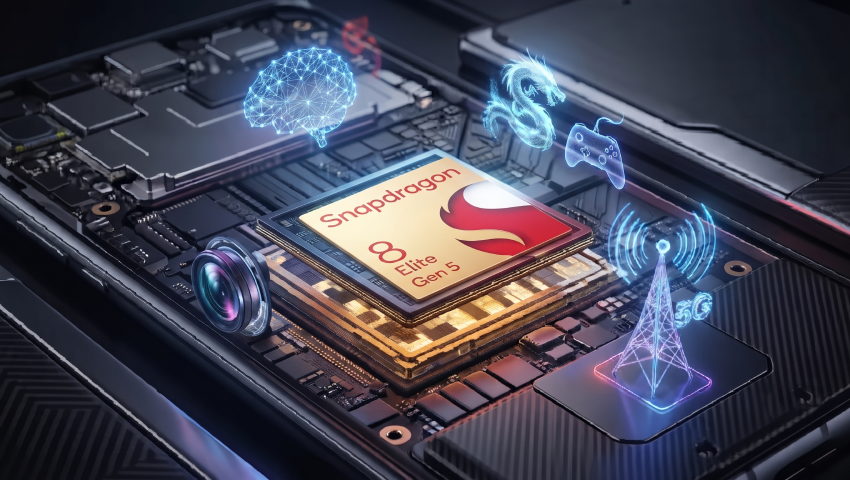
At its annual Snapdragon Summit a few weeks ago, Qualcomm announced its Snapdragon 8 Elite Gen 5 processor, touted as the world’s fastest integrated mobile processor. Theoretically, this is a huge leap forward, but will it translate to real-world smartphone performance?
While we await the arrival of the first smartphones to provide a definitive answer, we can begin to get a feel for the new chip’s performance thanks to Realme, which sent us a prototype equipped with Qualcomm’s latest chipset.
The device is still in its experimental stages, so we can’t discuss features like battery life, screen, and camera (and we can’t even show them to you!), but it’s an excellent testing ground for benchmarking performance and getting a glimpse of what to expect from the next generation of flagship Android phones.
Strategic Positioning: Solving the Silicon Cost Crisis
1. The Elite vs. Gen Series Schism
To understand the Snapdragon 8 Elite Gen 5, one must first understand the crisis of cost that precipitated its creation. As the industry moves toward 3nm and eventually 2nm manufacturing nodes, the cost per wafer has skyrocketed. Advanced packaging techniques, larger cache sizes, and complex thermal management solutions have pushed the price of top-tier silicon—exemplified by the Snapdragon 8 Elite—toward the $280 mark per unit. For an Original Equipment Manufacturer (OEM) attempting to build a device with a retail price of $600 to $800, allocating nearly 40% of the Bill of Materials (BOM) to the System-on-Chip (SoC) is economically untenable.
Qualcomm’s response is the “Gen” vs. “Elite” schism. The “Elite” branding is now reserved for the absolute zenith of performance, targeting devices that retail well above $1,000—the “Ultra” and “Pro Max” tier. The Snapdragon 8 Elite Gen 5 retains the numerical nomenclature to signal continuity with the flagship lineage (succeeding the Gen 3) while occupying a price point estimated to be significantly lower, potentially by as much as 50% according to some supply chain estimates compared to the Elite.
This segmentation allows Qualcomm to effectively double-dip in the premium market. They capture the high-margin halo sales with the Elite while simultaneously defending their market share against MediaTek’s surging Dimensity 9000 series in the high-volume sub-flagship tier. It is a classic “good, better, best” strategy, but executed at the very pinnacle of the performance chart rather than the mid-range.
2. The Economics of Flagship Killing
The Snapdragon 8 Elite Gen 5 is the engine of the “Flagship Killer” resurgence. In previous cycles, brands like OnePlus, Xiaomi (via POCO/Redmi), and Vivo (via iQOO) often had to rely on older flagship chips (e.g., using a Snapdragon 8 Gen 2 in a Gen 3 era) or use the “s” series chips (like the 8s Gen 3) to hit lower price points. While effective, these strategies often meant compromising on modem features, ISP capabilities, or utilizing older CPU architectures.
The Gen 5 changes this calculus. It offers current-generation architecture. It uses the same Third-Generation Oryon cores and N3P process node as the Elite. This means that a $699 device powered by the Gen 5 supports the same Wi-Fi 7 standards, the same Bluetooth 6.0 features, and the same fundamental AI software stack as a $1,200 device.
This creates a formidable value proposition. For the end consumer, the distinction between “Elite” and “Gen 5” is often invisible in daily tasks. App launch speeds, UI fluidity, and connectivity are virtually identical due to the shared IP blocks. The differentiation is pushed to the extremes: peak frame rates in ray-traced games, 8K video recording, and heavy multi-tasking—areas where the average consumer is far more price-elastic.
3. Consumer Segmentation: The Pragmatic Enthusiast
The target audience for the Snapdragon 8 Elite Gen 5 can be defined as the “Pragmatic Enthusiast.” This user profile is tech-savvy enough to understand specifications—they know they want a Snapdragon 8-series chip—but they are resistant to the diminishing returns of the ultra-premium market.
They prioritize:
- Sustained Performance: They prefer a phone that stays cool during a 30-minute commute gaming session over one that hits record benchmark scores but throttles after 5 minutes.
- Battery Life: They demand all-day endurance, which the Gen 5’s efficiency-tuned clusters provide.
- Value: They look for the “sweet spot” where they get 90% of the performance for 60% of the price.
This demographic is massive in high-growth markets like India, Southeast Asia, and China, where brands like iQOO, Realme, and Redmi dominate. The Gen 5 is tailor-made for these regions, allowing OEMs to market “Snapdragon 8 Elite Gen 5” power without the Elite price tag.
CPU Architecture: The Third-Generation Oryon Revolution
1. Custom Silicon: The Nuvia Legacy
The most significant technical achievement of the Snapdragon 8 Elite Gen 5 is its adoption of the custom Qualcomm Oryon CPU. This marks the complete departure from the era of “Kryo” cores, which were essentially semi-custom variations of off-the-shelf ARM Cortex designs. The Oryon architecture is the fruit of Qualcomm’s acquisition of Nuvia, a startup founded by former Apple silicon architects.
Why does this matter? Custom cores allow Qualcomm to decouple its roadmap from ARM’s standard release cycle. It allows for deeper optimization of the instruction pipeline, branch prediction, and execution units specifically for the thermal and power constraints of mobile devices, rather than using a general-purpose core designed for everything from automotive to servers. The Gen 5 utilizes the Third-Generation Oryon architecture, featuring a wider decoder width and deeper reorder buffers than previous iterations, translating to significant Instructions Per Clock (IPC) gains.
2. The 2+6 Core Topology: Death of the Efficiency Core
The Snapdragon 8 Elite Gen 5 employs a unique 2+6 octa-core configuration:
- 2x Prime Cores (Oryon): Clocked up to 3.8 GHz.
- 6x Performance Cores (Oryon): Clocked up to 3.32 GHz.
This topology is radical because it completely eliminates the traditional “efficiency” or “little” cores (e.g., Cortex-A520). In the past, little cores were necessary to handle background tasks at low power. However, the IPC and efficiency of the Oryon Performance cores are now high enough that they can handle background tasks efficiently at low frequencies, then ramp up instantly for heavy lifting. This “all-performance” strategy simplifies the scheduler’s job—there is no penalty for migrating a thread from a little core to a big core because all cores are capable.
Comparing this to the Elite, which runs its Prime cores at 4.32 GHz+, the Gen 5 is tuned for a different part of the efficiency curve. By capping the frequency at 3.8 GHz, Qualcomm avoids the exponential power ramp-up required to hit those final few hundred megahertz, likely resulting in a chip that runs cooler in daily operations.
3. Frequency Dynamics and Voltage Scaling
The decision to clock the Prime cores at 3.8 GHz is a masterclass in voltage-frequency scaling. In CMOS semiconductor physics, dynamic power consumption (P) is defined largely by the equation P = C . V2 . f, where C is capacitance, V is voltage, and f is frequency.
To achieve frequencies above 4.0 GHz on a mobile SoC, the voltage (V) must be increased significantly to ensure transistor switching stability. Because power scales with the square of the voltage, a small increase in frequency at the top end results in a massive increase in power and heat.
By strictly limiting the Gen 5 to 3.8 GHz, Qualcomm keeps the silicon in its “linear” efficiency zone. This means the chip delivers flagship-grade snapiness and responsiveness but generates significantly less heat per unit of work compared to an Elite chip running at full tilt. This behavior is corroborated by early benchmarks showing the Gen 5 maintaining excellent stability scores in throttling tests.
4. Memory Subsystem and Cache Pruning
Differentiation between the Elite and Gen 5 is most evident in the memory subsystem. Silicon die area is expensive, and SRAM (Static RAM used for cache) is one of the most area-intensive components.
- L2 Cache Reduction: The Prime cores in the Gen 5 utilize 4MB of L2 cache, compared to 12MB in the Elite. This is a massive 66% reduction.
- Impact: Smaller cache means the CPU must go to system memory (RAM) more frequently to fetch data. In latency-sensitive tasks like web browsing or general UI navigation, this difference is negligible due to the speed of LPDDR5X RAM. However, in “heavy footprint” workloads—such as compiling code, editing 4K video streams, or gaming with massive texture assets—the cache miss rate will be higher, leading to slightly lower frame rates or longer render times compared to the Elite.
- Die Size Reduction: This pruning allows the Gen 5 die to be approximately 104mm² versus the Elite’s 126mm². This 17% reduction in physical size is the primary driver of the cost savings, allowing more chips to be harvested from a single 300mm wafer.
Graphics Processing: Deconstructing the Adreno 840
1. Sliced Architecture Explained
The Snapdragon 8 Elite Gen 5 utilizes the Adreno 840 GPU, but nomenclature can be deceiving. While sharing the name with the GPU in the Elite (in some reports, or Adreno 830 in others, but functionally the architecture is the key), the physical implementation differs through “slicing.”
Modern GPUs are built from repeating blocks of compute units, texture mappers, and render backends. Qualcomm calls these blocks “slices.”
- The Elite GPU: Typically utilizes a 3-Slice configuration.
- The Gen 5 GPU: Utilizes a 2-Slice configuration.
- The Elite GPU: Typically utilizes a 3-Slice configuration.
- The Gen 5 GPU: Utilizes a 2-Slice configuration.
This means the Gen 5 has physically 33% fewer execution resources than the Elite. To bridge the performance gap, Qualcomm increases the clock speed of the remaining slices (up to 1.2 GHz or higher in bursts). This architectural choice is akin to desktop graphics cards where a lower-tier card (e.g., RTX 4070) uses the same architecture as the flagship (RTX 4090) but with fewer active cores.
2. Ray Tracing and Mesh Shading Integration
Despite the slice reduction, the Gen 5 retains the full feature set of the Snapdragon Elite Gaming suite. This is critical for compatibility. Developers do not need to write separate code for the Gen 5; features like Hardware-Accelerated Ray Tracing and Mesh Shading are present, just with lower total throughput.
- Ray Tracing: The Gen 5 can handle real-time global illumination, soft shadows, and reflections. In a game like War Thunder Mobile or Arena Breakout, enabling ray tracing might drop the frame rate more significantly on the Gen 5 than the Elite due to fewer intersection engines, but the feature works, which is the barrier to entry for next-gen mobile gaming.
- Mesh Shading: This allows the GPU to process complex geometry more efficiently, culling invisible triangles before they enter the pixel pipeline. For open-world games with vast draw distances, this helps the 2-slice GPU punch above its weight class by avoiding wasted processing.
3. Frame Interpolation: The Adreno Frame Motion Engine
To compensate for the raw horsepower deficit, the Gen 5 leans heavily on the Adreno Frame Motion Engine 2.1 (AFME). This is a hardware block dedicated to frame generation (interpolation).
- Mechanism: The GPU renders a game at 60 FPS, and the AFME inserts intermediate frames to output 120 FPS to the display.
- Benefit: This process consumes significantly less power than natively rendering at 120 FPS. For the Gen 5, this is a “killer app.” It allows the chip to deliver a 120Hz or 144Hz experience in demanding titles without overheating, effectively masking the raw performance gap vs. the Elite.
4. Thermal Efficiency and Sustained Performance
The 2-slice configuration creates a fascinating thermal dynamic. A physically smaller GPU concentrates heat, which can be a challenge. However, because there are fewer transistors firing overall, the total thermal design power (TDP) is lower.
Data indicates the Gen 5 operates comfortably in the 6W to 7W range under load. In contrast, the Elite can spike to 18W+ to achieve peak scores. Most smartphones, especially compact ones or those without active cooling fans, cannot sustain 10W+ dissipation for more than a few minutes before throttling. Therefore, in a standard 30-minute gaming session of Genshin Impact, the Gen 5 may actually offer more consistent frame rates. While the Elite throttles hard to protect itself, the Gen 5 chugs along at its efficient steady state. This paradox—”slower chip equals better sustained speed”—is the secret weapon of the Gen 5 for real-world gamers.
Artificial Intelligence: From Generative to Agentic
1. The Hexagon NPU Architecture
The Snapdragon 8 Elite Gen 5 represents a conceptual shift in mobile AI. The buzzword of 2024 was “Generative AI” (creating content). The focus for the current cycle is “Agentic AI” (taking action). The engine behind this is the upgraded Hexagon NPU (Neural Processing Unit), which is reported to be 46% faster than the Gen 3’s unit.
The Hexagon architecture is a “fused” design, combining:
- Scalar Accelerators: For simple, low-latency math.
- Vector Extensions (HVX): For complex image and audio processing.
- Tensor Accelerators: For the massive matrix multiplication required by Large Language Models (LLMs) and Transformers.
This fusion allows the NPU to switch between data types instantly without costly memory transfers, essential for the “bursty” nature of mobile AI interactions.
2. Quantization: INT4, INT2, and Precision
Running a 7-billion parameter model (like Llama 3) on a phone is a memory bandwidth nightmare. The Gen 5’s NPU solves this via advanced quantization support.
- INT4: Standard for mobile AI, reducing model size by 4x compared to FP16 with minimal accuracy loss.
- INT2: A capability emphasized in this generation. By compressing weights to just 2 bits, the Gen 5 can keep massive models resident in RAM. While INT2 can degrade accuracy, Qualcomm uses mixed-precision strategies (using INT2 for less critical layers and INT8/FP16 for sensitive ones) to balance performance and intelligence.
- FP8: A new floating-point format that provides a better dynamic range for generative tasks than integers, supported natively by the NPU.
3. The Sensing Hub and Contextual Awareness
The unsung hero of the Gen 5 is the Qualcomm Sensing Hub. This is a tiny, ultra-low-power island of silicon that never sleeps.
- Mechanism: It continuously aggregates data from the microphone, accelerometer, gyroscope, and ambient light sensor.
- Contextual Feature: The Gen 5 introduces a feature where the Sensing Hub can detect “user intent.” For example, it analyzes the specific motion of picking up the phone combined with ambient audio cues to “wake” the AI assistant before the user even presses a button or says a wake word. It creates a feeling of instant readiness.
- Agentic Capabilities: By maintaining a “Personal Knowledge Graph” on-device, the Sensing Hub allows the AI to know where you are (GPS/Wi-Fi), what you are doing (motion), and who you are with (voice biometrics), allowing for proactive suggestions (e.g., “You’re at the grocery store; here is the list you made earlier”).
4. Privacy and On-Device Processing
The shift to “Always-On” context awareness raises significant privacy red flags. Qualcomm addresses this by emphasizing that the Sensing Hub and NPU processing occur entirely on-device.
- Privacy Shield: Data from the Sensing Hub does not leave the device’s Trusted Execution Environment (TEE). The “Personal Knowledge Graph” is a local database, not a cloud profile.
- Hybrid AI: While the heavy lifting (like summarizing a 50-page PDF) might still go to the cloud if the local model is insufficient, the personal context data stays local, acting as a privacy filter before queries are sent out.
Connectivity and The Wireless Edge
1. Snapdragon X80 Modem-RF System
Connectivity is the backbone of the mobile experience. The Gen 5 integrates the Snapdragon X80 5G Modem-RF System. While some reports suggest the Elite uses an X85, the X80 is a formidable beast in its own right.
- Performance: Capable of 10 Gbps download and 3.5 Gbps upload.
- AI Beam management: The modem utilizes a dedicated Tensor accelerator to optimize sub-6GHz and mmWave beamforming. This is crucial for maintaining 5G speeds in challenging environments like crowded stadiums or urban canyons. The AI predicts blockage patterns and switches antennas faster than traditional heuristic algorithms.
- Satellite: Native support for Non-Terrestrial Networks (NTN) means the Gen 5 is ready for the era of satellite-to-cellular messaging, ensuring connectivity even in dead zones.
2. Wi-Fi 7 and HBS Multi-Link
The FastConnect 7900 subsystem enables Wi-Fi 7 with a peak speed of 5.8 Gbps.
- HBS Multi-Link (High Band Simultaneous): This is the killer feature for gamers. It allows the phone to connect to the router over both the 5GHz and 6GHz bands simultaneously.
- Result: If interference spikes on the 5GHz band (e.g., a microwave turns on), the data packets continue flowing uninterrupted on the 6GHz band. This virtually eliminates lag spikes, providing a wire-like connection reliability for cloud gaming services like Xbox Game Pass or GeForce Now.
- Power Efficiency: The system is built on a 6nm process (within the module) and uses AI to sleep the radio aggressively, reportedly consuming 40% less power than previous Wi-Fi 6E solutions.
3. Snapdragon Sound and XPAN
XPAN (Expanded Personal Area Network) is a breakthrough in audio connectivity.
- The Problem: Bluetooth range is limited. Walk into the next room, and your music cuts out.
- The Solution: XPAN allows audio to seamlessly bridge from Bluetooth to Wi-Fi. Because the Gen 5 supports micro-power Wi-Fi, it can stream lossless 96kHz/24-bit audio over Wi-Fi to supported earbuds, extending the range to the entire footprint of your home Wi-Fi network. You can leave your phone in the bedroom and listen to music in the backyard without a dropout.
Computational Photography and ISP Mechanics
1. Spectra Triple AI ISP Architecture
The Spectra Triple AI ISP (Image Signal Processor) is the visual cortex of the chip.
- Triple Concurrency: It can process streams from three cameras simultaneously. This is what enables smooth zooming—the ISP keeps the Ultra-wide, Wide, and Telephoto sensors all active and color-calibrated so that when you switch lenses, there is no stutter or color shift.
- Bit Depth: It supports 18-bit (or in some configs 20-bit) processing pipeline. This isn’t just about more colors; it’s about dynamic range. The ISP can handle the massive data output from modern “stacked” sensors (like the Sony LYT-808 or LYT-700V) without clipping highlights or crushing shadows.
2. Semantic Segmentation and Cognitive Processing
The ISP is “Cognitive,” meaning it is tightly coupled with the NPU for Real-Time Semantic Segmentation.
- How it works: As you frame a shot, the AI analyzes the video feed and segments it into layers: Sky, Skin, Hair, Fabric, Grass, Building, etc.
- The Application: It applies different processing rules to each layer in real-time.
- Sky: Noise reduction and blue saturation boost.
- Skin: Texture smoothing but preserving pore detail (avoiding the “plastic” look).
- Grass: Sharpening and green vibrancy.
- Result: The image looks professionally graded the instant you take it. This “Limitless” segmentation capability (up to 12+ layers) ensures that complex scenes with mixed lighting are handled correctly.
3. Video Capabilities and Limitations
Differentiation strikes again in video.
- 4K at 120 FPS: Fully supported. This allows for buttery smooth slow-motion playback that retains high resolution.
- 8K Limitations: While the silicon is theoretically capable of 8K, reports indicate it is often capped at 30fps or disabled in “Value Flagship” firmware to prevent thermal runaway or to upsell the Elite models. However, Night Vision 3.0 (AI video denoising) at 4K60 is a massive upgrade, making low-light videos usable where they would previously be a grainy mess.
Manufacturing and Lithography
1. TSMC N3P: The Node Advantage
The Snapdragon 8 Elite Gen 5 is fabricated on TSMC’s N3P node.
- Evolution: N3P is the performance-enhanced version of the N3E node (used for the Apple A18 and Snapdragon 8 Elite/Gen 4 early samples).
- Metrics: It offers roughly 5% more performance or 5-10% better power efficiency than N3E, and significantly better density than the N4P node used for the Gen 3.
- Significance: This confirms that the Gen 5 is not using “old” manufacturing tech. It is on the bleeding edge. The cost savings come from the smaller die size (fewer features), not from using an inferior process node.
2. Yield Management and Binning
The relationship between the Elite and Gen 5 manufacturing is a study in yield economics.
- Hypothesis: It is highly likely that the Gen 5 and Elite share DNA in their mask design, or the Gen 5 is a dedicated “harvesting” design. By designing a smaller die (104mm²) with reduced cache, Qualcomm fits approximately 20% more dies per wafer compared to the Elite (126mm²).
- Binning: Furthermore, chips that cannot hit the Elite’s 4.32 GHz targets due to silicon variances can potentially be fused off and sold as Gen 5 chips (if the physical layout allows), maximizing the revenue from every wafer processed.
3. The Samsung Foundry Variable
Persistent rumors suggest a strategic pivot involving Samsung Foundry. While the launch version is TSMC N3P, Qualcomm CEO Cristiano Amon has hinted at a multi-foundry approach.
- The 2nm Plan: There is speculation that a future variant (“Gen 5s” or similar) could be fabricated on Samsung’s upcoming SF2 (2nm) node.
- Implications: If true, this would be a massive endorsement for Samsung. However, enthusiasts remain wary due to past thermal issues with Samsung-fabbed chips (SD888, 8 Gen 1). For now, the TSMC N3P provenance of the Gen 5 is a major selling point for stability-focused users.
Performance Analysis and Benchmarking
1. Synthetic Metrics: Geekbench and AnTuTu
Early benchmarks for the OnePlus Ace 6T and comparable reference designs reveal significant performance differences across current flagship SoCs.
The Snapdragon 8 Elite Gen 5 (TSMC N3P, 2+6 CPU configuration at 3.8/3.32 GHz) delivers strong single-thread (~3,000) and multi-thread (~10,400) performance in Geekbench 6, with an AnTuTu v11 score of ~2,270,000.
The previous-generation Snapdragon 8 Elite (TSMC N3P, 2+6 at 4.32/3.53 GHz) achieves the highest early benchmark scores, with Geekbench 6 ST/MT scores of ~3,600 / 12,350 and AnTuTu ~4,160,000, reflecting superior clock speeds and optimized CPU cores.
The Snapdragon 8 Gen 3 (TSMC N4P, 1+5+2 Cortex configuration) shows moderate performance, scoring ~2,200 ST / ~7,000 MT in Geekbench 6 and ~2,270,000 AnTuTu, indicating lower efficiency despite the modern process node.
The Dimensity 9500 (TSMC N3E/P, 1+3+4 Cortex) delivers competitive multi-thread performance (~9,700 MT) and AnTuTu ~4,011,000, though single-thread scores (~3,177) lag slightly behind Qualcomm’s latest offerings.
Overall, the hierarchy highlights Snapdragon 8 Elite as peak performance, followed by Dimensity 9500 for multi-threaded workloads, 8 Elite Gen 5 for balanced efficiency, and 8 Gen 3 as a solid mid-tier contender, providing insight for both gaming and productivity benchmarks in the OnePlus Ace 6T.
Analysis:
The Gen 5 delivers a staggering ~45% multi-core improvement over the Gen 3. This is a generational leap rarely seen. While it trails the Elite by ~15%, it effectively renders the Gen 3 obsolete. The Single-Thread (ST) score of 3,000 places it in the upper echelon, ensuring “snappy” UI performance that rivals the iPhone 16 Pro’s A18 chip.
2. Competitive Landscape: Gen 5 vs. Dimensity 9500
This is the fiercest battle. The MediaTek Dimensity 9500 uses an “All Big Core” design (Cortex-X925) and typically scores higher in raw GPU benchmarks (AnTuTu comparisons).
- The Gen 5 Advantage: Driver maturity. Qualcomm’s Adreno drivers are legendary for their stability in emulators (Yuzu, AetherSX2) and niche games. MediaTek often struggles here.
- Modem Superiority: The X80 modem generally offers better mmWave throughput and global band support than MediaTek’s equivalent, making Gen 5 the preferred choice for global travelers and US carriers.
- The Verdict: If you want raw benchmark numbers, the Dimensity 9500 is a threat. If you want ecosystem stability, emulator support, and reliable connectivity, the Gen 5 wins.
3. Gaming Real-World Telemetry
Synthetic benchmarks don’t play games; users do. In Wuthering Waves (a notoriously heavy title):
- OnePlus Ace 6T (Gen 5): 59.1 FPS Average @ 6.6W power draw.
- Comparison: Achieving ~60fps at under 7W is the holy grail of mobile gaming efficiency. Many Elite devices draw 9-10W to hold this, leading to uncomfortable hand temperatures.
- Conclusion: The Gen 5 is the “Marathon Runner” to the Elite’s “Sprinter.” For competitive gamers playing 3-hour sessions of PUBG Mobile or Honor of Kings, the Gen 5 device may actually maintain a higher average frame rate over the full session because it won’t throttle as aggressively.
Device Ecosystem and Implementation
1. OnePlus Ace 6T / 15R Case Study
The OnePlus 15R (Ace 6T in China) is the poster child for the Gen 5.
- Price: ~$699 USD (Leaked/Estimated).
- Philosophy: It pairs the Gen 5 with a massive 7,000mAh+ battery (using Silicon-Carbon technology) and a 1.5K OLED screen.
- Result: A device that likely offers 2-day battery life and top-tier gaming performance for significantly less than a Galaxy S26 Ultra. This device proves that the “R” series is no longer a recycling bin for old chips but a premier destination for value.
2. The Compact Renaissance: Vivo S50 Pro Mini
The Vivo S50 Pro Mini utilizes the Gen 5 to solve the “Small Phone Problem.”
- Challenge: Small phones (6.3-inch) have less surface area to dissipate heat. Putting an Elite chip in one is asking for thermal throttling.
- Solution: The Gen 5’s lower peak power draw makes it perfect for this form factor. It delivers flagship speed without turning the chassis into a hotplate. This device features a 6.31-inch 1.5K screen and a surprisingly large 6,500mAh battery (thanks to the space saved by the smaller SoC die and Si/C battery tech).
3. Regional Availability and Pricing
- China: First wave (Nov/Dec). Aggressive pricing wars between iQOO, Redmi, and OnePlus.
- India: Launching Jan/Feb (e.g., Motorola Signature, OnePlus 15R). A key battleground where the sub-₹60,000 segment is vital.
- Global/US: Likely to appear in Motorola Edge devices and perhaps a future “FE” model from Samsung, though Samsung typically reserves the Spring launch for the S-series (Elite).
- Price Delta: The Gen 5 allows OEMs to undercut Elite devices by $200-$300. This price elasticity is expected to drive massive adoption in the “affordable flagship” segment.
Conclusion
As we’ve repeatedly emphasized, this is just a glimpse into the performance of the new flagship Snapdragon 8 Elite Gen 5 processor, which will undoubtedly deliver its best in the final versions of the smartphones it integrates into. But one thing is clear from these initial tests: we’re talking about a chip that will redefine the standards for flagship Android phones in 2026.
Of course, these tests should be treated with caution given that they are prototypes. However, it appears that Qualcomm’s partners will be getting an exceptional chip, capable of delivering superior user experiences, from gaming with unprecedented smartphone graphics and ray tracing, to advanced computational photography, and even on-device AI capable of performing highly complex tasks.
If these results are confirmed by final devices, 2026 promises to be an extraordinary year for mobile technology enthusiasts. All that remains is to wait for the first smartphones to hit the market and see if Qualcomm’s promises translate into a user experience that lives up to expectations.