


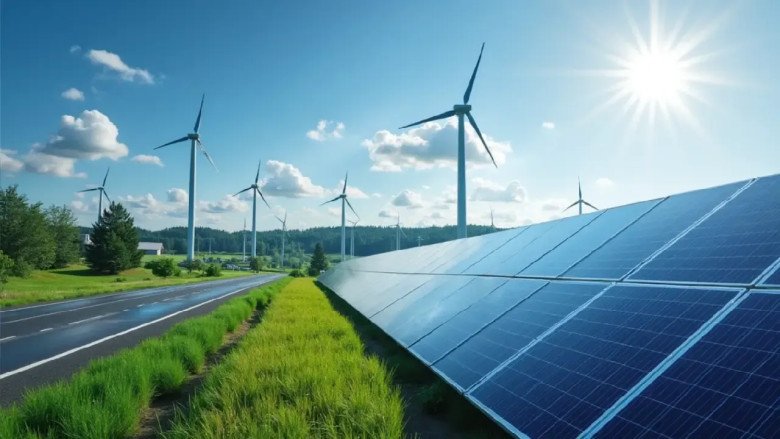
We stand at a monumental inflection point in human history. The insatiable global thirst for power, coupled with the critical, non-negotiable mandate to reverse climate change, has propelled Renewable Energy from a fringe concept to an undeniable, indispensable reality.
Defined by its limitless supply—drawn directly from the sun's brilliance, the wind's sheer force, the tides' predictability, and the Earth's inner heat—Renewable Energy is far more than just an alternative; it is the ultimate, long-term solution to the volatility, pollution, and geopolitical risks associated with fossil fuels.
This profound energy revolution is radically reshaping global industries, igniting vast economic growth, securing our energy sovereignty, and, most importantly, promising a genuinely clean atmosphere for generations to come. The transformative power and strategic importance of Renewable Energy cannot be overstated.
The Unavoidable Necessity: Why Renewable Energy is Non-Negotiable
The conversation surrounding energy has fundamentally shifted. It is no longer a debate driven by abstract environmentalism but a cold, hard calculation based on global risk and stability. The continued reliance on fossil fuels traps nations in a cycle of geopolitical vulnerability, market price shocks, and, most disastrously, runaway climate change. This makes the rapid, decisive shift toward locally-sourced Renewable Energy not just advisable, but a vital strategic imperative for every country seeking true stability and economic resilience.
1. A Cure for Climate Change and Toxic Air Pollution
At its core, the primary benefit of Renewable Energy is its near-zero operational emissions. Unlike the burning of coal, oil, or gas, the generation of solar or wind power releases no carbon dioxide, no sulfur dioxide, and no particulate matter into the atmosphere.
This technological distinction is the single most important factor in meeting global climate targets and, simultaneously, in purifying the air in our cities.
Public health organizations worldwide now link the uptake of green energy directly to massive reductions in respiratory and cardiovascular diseases, proving that the economic payoff extends far beyond the utility bill and into the realm of human well-being.
2. Securing the Future: Energy Sovereignty and Price Stability
For decades, global politics have been dictated by the concentration of oil and gas reserves. Renewable Energy shatters this paradigm by transforming energy from an imported commodity into a domestically-harnessed resource.
When a nation generates its power from its own sun, wind, or tides, it achieves genuine energy sovereignty. This eliminates the crippling risk of volatile international fuel prices, supply chain disruptions, and the need for military protection of distant energy routes.
Investing in Renewable Energy is, therefore, a massive investment in long-term national security and predictable economic growth for citizens and businesses alike.
Exploring the Core Technologies Driving the Renewable Energy Sector
The portfolio of Renewable Energy is wonderfully diverse, offering a tailored solution for nearly every geographical and climatic condition on Earth. The continuous improvement in these technologies is the engine of the energy transition, relentlessly driving down costs and making every new installation more efficient than the last.
1. Solar Power: Capturing the Energy of a Star
Imagine the elegant simplicity of converting sunlight—the most abundant energy source known to humanity—directly into usable power. That is the essence of solar power, which has become the most widely adopted and democratized form of Renewable Energy. It operates primarily through two powerful technologies.
-
- First, Photovoltaics (PV) use the silent, zero-emission process of semiconductor materials to turn photons into electrons.
- Second, Concentrated Solar Power (CSP) uses vast arrays of mirrors to heat a fluid that, in turn, drives a turbine, often featuring thermal storage for overnight power generation.
The sheer versatility of solar allows it to power remote villages, massive industrial complexes, and every single residential rooftop. This ubiquity, combined with a staggering cost reduction of over 90% in the last decade, has made solar power the undisputed heavyweight champion of accessible green energy worldwide.
2. Wind Energy: Harnessing Nature's Airflow
Wind power is the kinetic powerhouse of the Renewable Energy world, converting the movement of air into massive amounts of electricity. Modern wind farms have evolved into sophisticated engineering marvels, categorized primarily as onshore and offshore installations. While onshore turbines utilize favorable terrain like hills and plains, the true frontier lies offshore.
Offshore wind benefits from stronger, more consistent air streams and allows for the deployment of truly colossal turbines that are often three or four times the size of their land-based counterparts. Crucially, the newest generation of turbines features larger rotor diameters and smarter operating systems that significantly increase the capacity factor, making wind an increasingly reliable and predictable foundational element in a high-Renewable Energy grid.
3. Geothermal Energy: The Earth's Silent, Steady Power Source
While solar and wind are intermittent, geothermal energy taps into the virtually inexhaustible, continuous thermal heat within the Earth's core. This heat is brought to the surface as steam or hot water, used directly to drive turbines for electricity or circulated through heat pumps for highly efficient building heating and cooling.
The most extraordinary feature of geothermal is its ability to provide 24/7 baseload power, operating reliably regardless of weather conditions or time of day. Though traditionally confined to tectonically active zones, breakthroughs in drilling and 'Enhanced Geothermal Systems' (EGS) are steadily unlocking this silent, powerful form of Renewable Energy in regions previously thought impossible, revealing a massive, reliable resource beneath our feet.
4. Hydropower and Bioenergy: Stability and Flexibility
Hydropower—the oldest form of electricity generation—and bioenergy provide unique stability and flexibility to the overall Renewable Energy matrix. Hydropower offers unmatched grid stability, with pumped hydro storage acting as the single largest battery in existence, able to ramp up and down in seconds to balance the grid.
Bioenergy, derived from organic materials like crops, waste, and agricultural residues, is unique because it is storable and dispatchable, meaning it can be used on demand, just like a fossil fuel plant, but with a theoretically carbon-neutral footprint if managed correctly.
The applications of sustainable bioenergy are diverse and essential for filling critical energy gaps:
-
- Flexible Power Generation: Burning sustainable biomass in power stations provides an 'on-demand' source of Renewable Energy when the sun or wind is low.
- Renewable Fuels: The production of advanced biofuels (e.g., bioethanol, biodiesel) is crucial for decarbonizing sectors like heavy transport (shipping and aviation) where direct electrification remains a complex challenge.
- Waste Management Integration: Utilizing methane-rich biogas from landfills or food waste through anaerobic digestion not only generates power but also prevents a potent greenhouse gas from escaping into the atmosphere, making it a powerful double win for green energy.
The Economic Powerhouse of Renewable Energy and Future Outlook
The shift toward Renewable Energy is now financially inevitable. Global investment in the sector consistently outpaces that in fossil fuels, driven by the profound realization that the technology has achieved—and in many cases surpassed—cost parity with conventional sources. This economic viability has turned Renewable Energy into the dominant force for all new power generation capacity additions worldwide. The long-term security of zero fuel costs and the strong hedge against future carbon pricing make these projects universally appealing to major financial institutions.
1. The Triumph of the Cost Curve
Nothing illustrates the success of Renewable Energy more clearly than the Levelized Cost of Electricity (LCOE) data. The LCOE for both solar and wind power has plummeted so dramatically that, in a vast majority of the world, building new Renewable Energy plants is now demonstrably cheaper than simply continuing to operate existing, aging fossil fuel facilities. This economic advantage is the single most powerful driver of the energy transition.
This unprecedented cost competitiveness is the result of focused, sustained human effort:
-
- Manufacturing Scale-up: The massive, gigawatt-scale production of solar panels and standardized wind turbine components has introduced unprecedented economies of scale, dramatically cutting production costs.
- Technological Maturation: Continuous, targeted research into material science, turbine blade design, and power electronics squeezes more efficiency out of every installed unit, maximizing energy output for the same capital investment.
- Logistical Streamlining: The standardization of project development, financing structures, and installation processes has significantly reduced the 'soft costs' of deployment, making project execution faster and less capital-intensive.
2. Innovation: The Critical Role of Energy Storage
The future expansion of Renewable Energy hinges on overcoming its final frontier: large-scale, cost-effective energy storage. Intermittency—the unavoidable reality of the sun setting and the wind dropping—requires flexible solutions to ensure the grid remains stable.
Today, lithium-ion batteries lead the charge, providing short-duration flexibility, but the horizon holds solutions like pumped hydro, compressed air, and, most excitingly, 'green hydrogen'—produced using Renewable Energy—which can store enormous amounts of energy for long durations, effectively providing the season-to-season flexibility needed for a 100% Renewable Energy grid.
Innovating Past the Grid and Storage Challenges
A complete shift to Renewable Energy requires more than just building panels and turbines; it demands a total overhaul of the electric grid infrastructure. We must invest heavily in transmission upgrades to move power efficiently from resource-rich but often remote areas (like vast desert solar farms or deep offshore wind zones) to densely populated cities.
Furthermore, the 'smart grid' revolution, utilizing AI and advanced sensors, is essential to manage the dynamic, two-way flow of power characteristic of a distributed Renewable Energy system.
Finally, responsible sourcing of the raw materials required for these technologies—like lithium, cobalt, and rare earth metals—is a human and environmental necessity that must be met with stringent, ethical supply chain practices to ensure the green energy transition is truly sustainable from the ground up.
The Final Verdict: The Unstoppable Trajectory of Renewable Energy
The comprehensive, global pivot toward Renewable Energy is not just an environmental choice—it is a landmark achievement in human engineering and economic wisdom. It represents a critical and optimistic convergence where ecological necessity, strategic energy security, and undeniable market forces align perfectly.
From the massive scale of utility solar to the localized resilience of decentralized wind power, Renewable Energy technologies are not merely replacing old energy sources; they are building a fundamentally better, more stable, and more equitable energy system. The question is no longer if the world will embrace Renewable Energy, but how fast we can accelerate this inevitable and beneficial shift.
The foundations for a secure, prosperous, and truly sustainable future have been laid. We must now collectively commit to the final push. Embrace this green revolution: the age of abundant, secure, and clean power, fueled by Renewable Energy, is not just coming—it has finally arrived.
Renewable Energy Revolution The Future of Clean Power
You may also like
-

How to Optimize Your Website for Google SGE & Win AI Search
-
The Engineering Secrets Behind Ancient Megastructures
-
OpenAI Sora vs Midjourney v6: Best AI Tools for Marketers
-
Midjourney v6: The Complete Guide to Advanced Prompts & Photorealism
-
The Rise and Fall of OpenAI Sora: What Happened to the Video AI Giant?
-
Apple Watch Series 11 Review: Is It Worth the Upgrade?




















Comments
0 comment