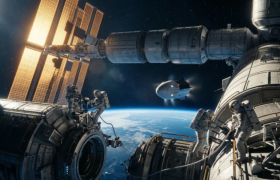
Commercial Space Stations: What Happens After the ISS Retires?
Discover what happens after the ISS retires. Explore how commercial space stations and private orbital habitats are driving the new low Earth orbit economy.




 by Simo Naboussi
 The universe is an endless expanse, filled with wonders that often defy the boundaries of human imagination, but perhaps none are more awe-inspiring, or more fundamentally violent, than the objects we call Quasars. Imagine a single beacon of light, so incredibly potent that it outshines a thousand entire galaxies combined, a cosmic lighthouse shining from the very dawn of creation.
These were the perplexing "quasi-stellar radio sources" that baffled scientists for years, initially appearing as faint, star-like points through visible light telescopes, yet screaming with the radio-wave power of entire galactic clusters. They seemed to break every known rule of physics simply by existing.For decades, the nature of Quasars—a contraction of "quasi-stellar radio source"—remained one of the most compelling mysteries in astrophysics. Their immense distance, confirmed by their extreme redshift, suggested a light source that was both impossibly far away and impossibly bright.
The revelation finally came: a Quasar is not a star, but the hungry, luminous scream of a supermassive black hole (SMBH) actively feasting at the core of a distant, young galaxy. Studying them is not just about astronomy; it's about time travel, allowing us to unlock the deepest secrets of cosmic evolution and the universe's formative years.
At their core, Quasars are the most spectacular example of an Active Galactic Nucleus (AGN). They represent a brief, tumultuous, and highly active phase in the life of a young galaxy. While every large galaxy, including our own Milky Way, harbors a supermassive black hole at its center, it is only when this black hole is actively feeding at an astonishing rate that the phenomenon transforms into a Quasar.
To fully appreciate the intensity of a Quasar, it helps to outline its defining observational traits, which distinguish it from a normal galaxy or even other, milder forms of AGN:
These combined properties paint a picture of an object driven by the most powerful gravitational engine known to physics.
What powers this unimaginable brilliance? The answer lies in the most ferocious, yet most efficient, engine in the cosmos: the supermassive black hole (SMBH). It is a common misconception that black holes are cosmic vacuum cleaners, quietly sucking matter from the universe. In the heart of a Quasar, the reality is far more dramatic: the black hole is messy, violent, and incredibly luminous.
The true light source isn't the black hole itself, which remains forever dark behind its event horizon. Instead, the luminosity comes from the swirling, superheated traffic jam of matter just before it crosses the point of no return—a structure known as the accretion disk. This is where the magic happens:
It is this highly efficient conversion process—mass into pure energy—that turns a silent black hole into the most potent cosmic lighthouse in the universe.
The Quasar's staggering luminosity is more than just a spectacle; it is a critical measure of the central engine's activity. To maintain their observed brilliance, these supermassive black holes must be accreting matter at a rate that can reach the equivalent of several Earth masses per minute, or even entire solar masses per year. This feeding rate is often regulated by a theoretical limit known as the Eddington Limit.
The Eddington Limit defines the maximum rate at which a black hole can accrete matter. Why is there a limit? Because the light and radiation generated by the accretion disk—the very thing we see—exert an intense outward pressure.
If the black hole tries to swallow matter too quickly, the outgoing radiation pressure becomes so strong that it pushes the remaining infalling gas and dust away, essentially choking the black hole.
Quasars are often observed accreting at or near this maximum theoretical limit, a state of cosmic equilibrium between gravitational infall and radiation output.
This immense power has a profound, even destructive, impact on the surrounding galaxy—a process known as AGN Feedback. The high-energy radiation and ultra-fast, massive outflows of gas generated by the Quasar are thought to be the principal force driving galaxy evolution:
Thus, the brilliance of a Quasar is not a static glow, but the light from a cosmic event that fundamentally alters the destiny of its entire galaxy.
The confirmation of the true nature of Quasars depended entirely on measuring their redshift. Redshift is the cosmological phenomenon where the light from a distant object is stretched—or shifted towards the red end of the spectrum—due to the continuous expansion of the universe. The greater the redshift, the faster the object is receding, and crucially, the farther away it is. Because light takes time to travel, observing a high-redshift Quasar means we are looking billions of years into the past.
Quasars hold the record for some of the highest redshifts ever measured for complex, energetic objects. Observing one with a redshift approx means the light has travelled over 13 billion years, showing us the object as it existed less than a billion years after the Big Bang. They are our direct probes into the universe's infancy.
Due to their immense and consistent luminosity, Quasars serve as perfect background light sources. As the Quasar's light travels the vast cosmic distance to Earth, it passes through intergalactic gas clouds—mostly hydrogen—that fill the voids between galaxies. Each cloud absorbs a specific wavelength of the light, leaving a distinct dark line on the Quasar’s spectrum. Scientists refer to this multitude of absorption lines as the Lyman-alpha forest.
Detailed analysis of this "forest" allows scientists to:
In essence, the light from these distant powerhouses acts as a cosmic flashlight, illuminating the otherwise invisible structure of the early, evolving universe.
While all Quasars share the same basic engine—an SMBH with an accretion disk—they look dramatically different depending on our viewing angle. This concept is formalized in the Unified Model of AGN, which explains the different classifications of Quasars and related AGN based on how much the central engine is obscured from our line of sight.
The primary observational differences often come down to two features:
The key features that differentiate the visible Quasar classes are:
Understanding these subtle differences is paramount, as they confirm that we are not looking at fundamentally different objects, but rather observing the same powerful engine from diverse cosmic perspectives.
The study of Quasars is not just about decoding a single celestial object; it is about providing the essential pieces for the greatest puzzle in all of cosmology: how the universe evolved from a uniform soup of gas into the rich tapestry of galaxies we see today. Quasars represent the moment the universe switched on its high-powered lights, profoundly affecting all matter around them.
The critical information derived from Quasar research:
Every photon of light reaching us from a Quasar carries the signature of fundamental physics and cosmic history, making them truly invaluable to the scientific community.
From their mysterious radio signals that puzzled the first observers to their current status as the universe's most luminous, distant, and powerful objects, Quasars have undeniably shaped modern astrophysics. They are not merely objects of academic curiosity; they are vital, explosive signposts marking the dramatic epoch of early galaxy formation and the profound, transformative growth of supermassive black holes.
These brilliant cosmic engines demonstrate the astonishing power released when matter succumbs to the gravitational pull of a black hole, providing an unparalleled view into the most energetic processes in nature.
The journey into understanding Quasars is far from over. As next-generation instruments like the James Webb Space Telescope continue to push the boundaries of detection, they promise even deeper and sharper views, allowing us to witness the moment the very first Quasars ignited.
Ultimately, the study of these enigmatic objects is an exploration of the fundamental laws of physics and the grand narrative of the universe itself, ensuring their continued status as the most fascinating and powerful quasi-stellar objects in the celestial sphere. Quasars are the voice of cosmic history, and we are only just learning how to listen.
 Mar 15, 2026
 Discover what happens after the ISS retires. Explore how commercial space stations and private orbital habitats are driving the new low Earth orbit economy.
 Feb 01, 2026
 Explore the technical bottlenecks stalling NASA’s Artemis program and how China’s methodical lunar strategy could allow Beijing to claim the strategic South Pole first.
 Dec 26, 2025
 Is space travel the ultimate destiny of humankind? Explore the evolution of cosmic exploration, the grit of Mars missions.