


Imagine a computer that doesn't just calculate one possibility at a time, but calculates every single possibility simultaneously. That's the mind-bending promise of quantum computing. For the last half-century, our digital world has been built on the 'bit'—a simple switch that is either ON (1) or OFF (0). This classical framework has taken us incredibly far, yet when we face truly monumental challenges—like simulating complex molecules, cracking next-generation encryption, or optimizing global logistics—our fastest supercomputers still grind to a halt. We've hit a computational wall.
The solution? Turning to the deepest, strangest laws of physics: quantum mechanics. Quantum computing isn't just a faster version of what we have; it's a completely different way of thinking about and processing information. It harnesses phenomena that sound like science fiction—existing everywhere at once and being mysteriously linked across space—to solve problems that are currently impossible. This is a field poised to shatter industry norms and redefine the limits of scientific exploration. Let’s dive deep into the fundamental concepts and staggering implications of this transformative technology.
The Fundamental Shift: From Classical Bits to Quantum Qubits
To grasp the power of a quantum computer, you must first understand its foundational unit: the qubit (quantum bit). The classical bit is black or white, 0 or 1. The qubit, however, operates in a gray area, thanks to two bizarre quantum principles that give it exponential computational muscle.
1. Superposition: The Genius of Being Everywhere at Once
The first and arguably most critical concept is superposition. Think of a classical bit as a light switch: it's either definitely on or definitely off. A qubit, on the other hand, can be thought of as a spinning coin. Until that coin lands (i.e., until the state is measured), it is simultaneously heads and tails.
This means a single qubit can represent a blending of 0 and 1, holding two pieces of information at once. The real magic begins when you scale this up. A machine with just N qubits can exist in 2 N states simultaneously.
For a computer with only 300 qubits, the number of parallel states it can explore exceeds the number of atoms in the entire observable universe! This capacity for massive parallel processing is the engine that drives the theoretical speed advantage of quantum computing over everything else we’ve built.
2. Entanglement: Einstein's "Spooky Action at a Distance"
While superposition gives individual qubits their incredible potential, entanglement is what allows them to work together in a synchronized, computational harmony. Entanglement occurs when two or more qubits become linked in such a way that they share the same fate, regardless of the physical distance separating them. If you measure the state of one entangled qubit, you instantly know the state of the other. They are correlated in a way that is utterly impossible in the classical world.
In a quantum computer, entanglement creates a deeply connected network of qubits. It allows the machine to explore complex relationships between the $2^N$ possible solutions simultaneously, rather than processing them independently. This connectivity is the second fundamental resource—the crucial 'glue'—that allows quantum algorithms to find a needle in an enormous haystack far faster than any brute-force classical search could ever hope to manage. Without entanglement, a quantum machine is just a collection of confused, parallel switches.
How Quantum Machines Think: Architecture and Fragility
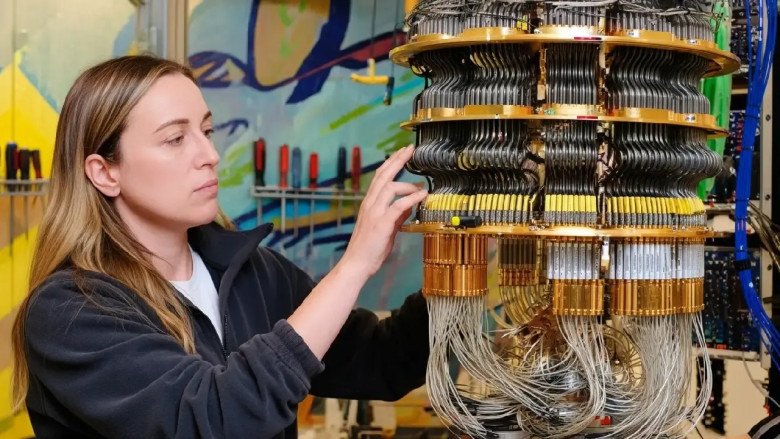
Building a quantum computer requires manipulating the most delicate particles in the universe, which is an engineering nightmare. Unlike a classical machine that runs on simple electrical currents, a quantum machine is literally built on fundamental physics. The processor isn't a chip you can casually hold; it's often a highly complex apparatus designed to shield its precious qubits from the tiniest disturbance.
1. The Competing Technologies: A Race for the Best Qubit
The technology for creating and maintaining qubits is still rapidly evolving. The research community is currently pursuing several promising architectures, each with its own trade-offs regarding stability, scalability, and error rates:
Here are the leading platforms currently driving research:
-
- Superconducting Circuits: These are tiny loops of superconducting wires kept at temperatures colder than deep space (near absolute zero). This platform is backed by major tech giants and benefits from existing semiconductor fabrication techniques, making it currently the most scalable approach.
- Trapped Ions: This method suspends individual charged atoms (ions) in a vacuum using electromagnetic fields. The energy states of these ions act as qubits. Trapped ion systems often boast the highest fidelity and lowest error rates, essentially providing the 'cleanest' computation, though scaling them up is highly challenging.
- Photonic (Light-Based) Systems: This approach uses photons (particles of light) as the qubits. Photons are excellent carriers of quantum information and can operate at room temperature. The challenge here lies in reliably generating and interacting with single photons within a complex circuit.
2. The Challenge of Decoherence: The Ultimate Enemy
The single greatest obstacle preventing us from having a universal, everyday quantum computer is decoherence. Remember how fragile superposition is? Any interaction with the outside world—a stray photon, an infinitesimal vibration, a temperature fluctuation—causes the qubit to instantly 'collapse' its superposition, destroying the delicate computation. It’s like trying to hold a conversation in a massive, noisy concert hall.
To overcome this, engineers employ extreme isolation (cryogenics, vacuum chambers) and a complex strategy called Quantum Error Correction (QEC). QEC is essential because, unlike classical errors that can be fixed by checking a copy, you can't check a quantum state without collapsing it. Instead, QEC schemes distribute the information of one 'logical' qubit across many highly correlated 'physical' qubits, using the group's collective state to detect and correct errors without destroying the underlying information. This transition to reliable, fault-tolerant quantum machines is the current frontier.
The Game-Changing Algorithms and Their Applications
A quantum machine is useless without the specialized code to run on it. Quantum computing requires entirely new algorithms designed to leverage superposition and entanglement for specific, high-value tasks. These algorithms offer what’s known as a 'quantum advantage'—a definitive speed-up over the best-known classical method.
1. Revolutionizing Materials Science and Drug Discovery
Perhaps the most intuitive and powerful application lies in simulation. Nature itself is quantum, so simulating molecular interactions is exponentially difficult for classical computers. A quantum computer, being inherently quantum, is perfectly suited for this task. This power will be channeled into:
-
- Drug Development: Accurately modeling how new drug candidates interact with human proteins, drastically speeding up the discovery phase and lowering costs.
- Materials Innovation: Designing novel materials from the ground up, such as room-temperature superconductors, highly efficient solar cells, or lighter, stronger alloys that today are beyond our simulation capability.
- Catalyst Design: Finding highly efficient industrial catalysts that could reduce global energy consumption, for example, by optimizing the highly energy-intensive process of fertilizer production.
2. The Algorithm That Changes Everything: Shor's Threat
The most famous quantum algorithm is Peter Shor's, which can factor large numbers exponentially faster than any classical method. This is not just a theoretical speedup; it’s a civilization-level threat. Since the security of nearly all modern public-key cryptography (like the RSA encryption used for online banking, email, and secure communication) relies entirely on the difficulty of factoring large numbers, a sufficiently large quantum computer running Shor’s algorithm would instantly shatter our current global security infrastructure.
The Quantum Security Paradox: Threat and the Race to Defend
The threat posed by Shor's algorithm is so profound that the intelligence community and governments around the world refer to it as "the quantum security paradox." The time to panic hasn't quite arrived, but the time to prepare is already here. Even if a powerful quantum machine is five to ten years away, sensitive data being stored today—often called 'harvest now, decrypt later' data—is vulnerable.
The global response is a frantic race to develop and standardize Post-Quantum Cryptography (PQC). PQC is a collection of new mathematical cryptographic systems designed to be secure against attacks from both classical supercomputers and future quantum computers. The world is migrating away from factorization-based security towards new paradigms based on complex mathematical problems like lattice-based cryptography, which even a quantum machine would find computationally infeasible. This migration is arguably the most critical and complex infrastructure change facing the digital world today.
The Reality Check: Challenges and the Near-Term Future
We need to be honest: while the potential of quantum computing is limitless, we are still a long way from a universal, fault-tolerant machine. The current era is one of "Noisy Intermediate-Scale Quantum (NISQ)" devices. These machines have a decent number of qubits (often 50-100+) but are plagued by the high error rates inherent in their operation. They are too noisy for the complex algorithms that require millions of qubits.
To move from NISQ to true, beneficial quantum advantage, the following hurdles must be overcome:
-
- Scalability: We need to figure out how to reliably interconnect thousands, and eventually millions, of qubits without dramatically increasing the error rate—a challenge that requires completely new approaches in physics and engineering.
- Fault Tolerance: The QEC overhead is enormous. Today, it might take 1,000 physical qubits to create one reliable logical qubit. We need far more efficient methods to make the technology practical.
- Algorithm Development: We must move beyond Shor and Grover to find and optimize new algorithms specifically designed for the noisy, limited architectures of the near term.
- Accessibility: Developing the software and programming tools to make quantum machines accessible to the average programmer, moving it out of the exclusive domain of theoretical physicists.
The near-term future is less about a massive, instant revolution and more about quantum-classical hybrid solutions. This model sees a classical supercomputer handling the bulk of the data processing while the quantum processor is used as a specialized, ultra-powerful co-processor to handle only the computationally hardest core of the problem. This synergistic approach will likely deliver the first meaningful commercial quantum advantage.
You may also like
-

How to Optimize Your Website for Google SGE & Win AI Search
-
The Engineering Secrets Behind Ancient Megastructures
-
OpenAI Sora vs Midjourney v6: Best AI Tools for Marketers
-
Midjourney v6: The Complete Guide to Advanced Prompts & Photorealism
-
The Rise and Fall of OpenAI Sora: What Happened to the Video AI Giant?
-
Apple Watch Series 11 Review: Is It Worth the Upgrade?




















Comments
0 comment