


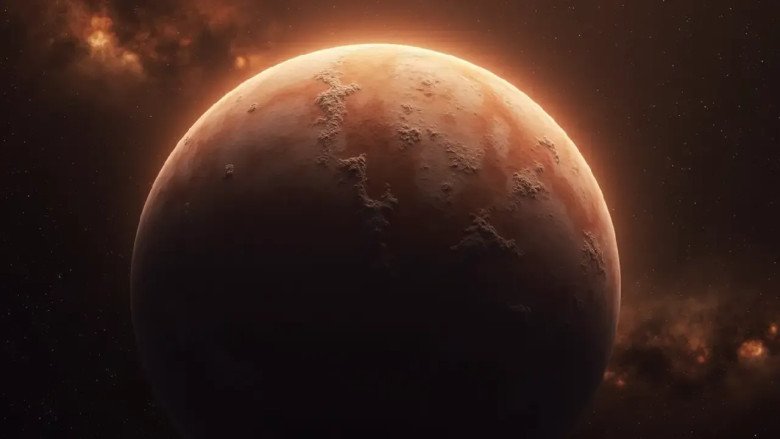
Imagine a world so fast it was named after the Roman messenger of the gods, a place so close to the Sun that its temperatures swing wildly enough to melt lead on one side and freeze gases on the other.
This isn't a sci-fi landscape; it is the reality of Planet Mercury. As the Solar System’s smallest and innermost planet, Mercury is often mistakenly viewed as a simple, baked rock, but decades of dedicated space exploration have proven this assumption spectacularly wrong.
It is a world of bewildering contradictions: a massive metallic heart, a shrinking surface, a trace atmosphere, and, most surprisingly, substantial deposits of water ice. For anyone seeking a truly deep dive into planetary science, understanding Planet Mercury is essential.
This detailed exploration uncovers the secrets of this terrestrial marvel, from its unique celestial mechanics to the groundbreaking findings that have rewritten its scientific biography.
Physical Enigma: The Colossal Core and Extreme Density of Planet Mercury
At a mere 2,440 kilometers in radius, Planet Mercury is a cosmic underdog, only slightly larger than Earth's Moon and smaller than several moons in the outer Solar System. Yet, this diminutive size hides an extraordinary secret regarding its internal composition. Mercury boasts an astonishingly high density, second only to Earth, due to its outsized metallic heart. Scientists were genuinely stunned when the data confirmed the proportions of this internal structure.
✅ The Heart of Iron: A Core That Dominates the Planet
The high density is no accident; it is the direct result of a gigantic, iron-rich core that is estimated to occupy a mind-boggling 60% of the planet's entire volume. This figure is wildly disproportionate compared to Earth, whose core only makes up about 17%. The scale of this metallic concentration is a major puzzle in planetary formation theory.
Current evidence, supported by magnetic field data, suggests this core is layered, featuring a solid iron inner core surrounded by a partially molten outer shell. This molten layer is absolutely crucial because it is the engine powering the planet's magnetic field through the dynamo effect—an incredible finding for such a small, rapidly cooling world.
The existence of such a massive core has led to tantalizing and often-debated theories about its origin. One leading hypothesis posits that Mercury was once much larger, possessing a thicker silicate mantle.
Early in the Solar System’s history, however, it may have suffered a cataclysmic collision—a massive impact that stripped away most of its rocky outer layers, leaving behind the dense, core-dominated structure we observe today.
Another model suggests that the intense heat of the early Sun vaporized much of the silicate material that was attempting to accrete near its orbit, leaving the heavier, more heat-resistant iron to form the majority of the planet.
The Orbital Paradox: Unpacking Mercury's Bizarre Day and Year
True to its mythological namesake, Planet Mercury is defined by its speed. It hurtles around the Sun at a blistering average velocity of nearly 47 kilometers per second, making it the speediest planet in our solar neighborhood. This pace gives it the Solar System's shortest year—just 88 Earth days. But it is the combination of this speed and its surprisingly slow spin that creates a truly unique time-keeping paradox.
✅ The 3:2 Spin-Orbit Lock: A Celestial Balancing Act
For centuries, astronomers were convinced that Mercury was gravitationally locked to the Sun, always showing the same face, similar to the Moon and Earth. Radar observations in 1965 shattered this notion, revealing a phenomenon known as a 3:2 spin-orbit resonance. This means that for every two orbits it completes around the Sun (two Mercurian years), Planet Mercury rotates exactly three times on its axis. This celestial synchronization is a slow-motion dance caused by the Sun's powerful tidal forces.
The result of this 3:2 resonance is an extraordinary time warp: the time from sunrise to sunrise (a solar day) on the surface of Mercury is approximately 176 Earth days—a period exactly twice as long as its year! This unique rotational cycle, combined with the planet’s highly eccentric orbit, creates an environment of truly brutal temperature extremes:
-
- Daytime: The equator can reach a blistering 430°C (800°F).
- Nighttime: Temperatures plummet to an unimaginable -180°C (-290°F) in the absence of an atmosphere.
This enormous, 610-degree Celsius swing between day and night is the largest temperature variation of any planet in the solar system, making Planet Mercury the epitome of an extreme world.
A History Written in Craters: The Scarred Surface and Geological Contraction
At first glance, the surface of Planet Mercury looks like a twin of Earth’s Moon: heavily pockmarked by impacts from the early Solar System. It's a fossil record of astronomical violence, preserved due to the lack of wind or water to erode the features. Yet, upon closer inspection, the detailed geology reveals a distinctive character shaped by contraction and unique surface processes.
1. The Monumental Caloris Basin
The most recognizable feature on Mercury is the immense Caloris Basin, a testament to an unimaginable impact event. This impact structure measures approximately 1,550 kilometers across, making it one of the largest impact features in the entire solar system.
The sheer force of the collision was enough to propagate intense seismic waves through the planet’s entire body. These waves converged on the opposite side (the antipodal point), where they created a bizarre, chaotic, and hilly terrain that scientists simply dubbed the "Weird Terrain."
The basin itself was later flooded by ancient volcanic lava flows, creating smooth plains that provide valuable insight into the planet’s early, more volcanically active state.
2. The Mystery of Scarps and "Hollows"
One of the strongest indicators of Mercury's geological uniqueness is the vast network of gigantic cliffs, known as scarps, that stretch for hundreds of kilometers across the surface. These are not erosion features; they are immense geological thrust faults created as the planet cooled and its massive iron core contracted.
Over its history, scientists estimate that Planet Mercury has shrunk in radius by as much as 7 kilometers, buckling the crust and pushing the surface material upwards to form these distinctive, towering cliffs.
Further exploration by the MESSENGER spacecraft revealed another fascinating, yet puzzling, feature: peculiar, shallow, irregularly shaped pits called hollows. These depressions appear surprisingly fresh and bright, suggesting they are young geological features.
The prevailing theory is that they are formed by the rapid sublimation (direct transition from solid to gas) of volatile materials, such as sulfur and chlorine compounds—elements that were unexpectedly abundant on Mercury’s surface—under the intense solar radiation. Their existence proves that Mercury is not a geologically dead world; its surface is still being actively modified in subtle but fascinating ways.
The Great Contradictions: Polar Water Ice and the Surprising Magnetic Field
Perhaps the two most astonishing scientific discoveries made on Planet Mercury are the confirmation of water ice deposits and the detection of a global magnetic field. Both of these features are fundamentally unexpected on a scorching hot world so close to the Sun, and their existence has pushed scientists to rethink models of planetary evolution.
1. The Icy Shadows: Water Trapped in Cold Traps
How can ice survive where temperatures soar to 430°C? The answer lies in the planet's virtually zero axial tilt—less than 0.027 degrees. Because of this tiny tilt, the Sun's rays never reach the floors of deep craters located near the north and south poles. These deep shadows act as perpetual cold traps, where temperatures remain constantly cold enough to keep water frozen.
The ice, confirmed by radar and direct measurements from the MESSENGER spacecraft, likely originated from comets or asteroids that impacted the planet over billions of years. This incredible find cemented the idea that water is far more prevalent in the inner Solar System than previously believed.
2. A Miniature Shield: The Persistence of Mercury's Magnetosphere
The discovery of a global magnetic field by Mariner 10 was a major shock. Conventional theory suggested that a planet as small as Planet Mercury would have cooled completely by now, solidifying its core and halting the dynamo process. Yet, the field persists, albeit at about 1.1% the strength of Earth's. The fact that the core is still churning and generating a field is compelling evidence that a portion of the outer core must still be molten, or that the process operating there is dramatically different from that on Earth.
This magnetic field is strong enough to create a miniature magnetosphere, which acts as a protective shield against the brutal solar wind. This interaction is not always smooth, however. Data has shown that the solar wind's constant pressure can create peculiar magnetic structures known as magnetic tornadoes, which twist and funnel plasma directly down to the planet's surface, constantly eroding and changing the composition of the crust and exosphere.
The Whispering Veil: Mercury's Tenuous Exosphere and Comet-like Tail
Planet Mercury does not possess an atmosphere in the traditional sense. It lacks the sufficient gravity and is too close to the Sun to hold onto a thick, stable blanket of gas. Instead, it is surrounded by an ultra-thin layer of gas called an exosphere. This layer is so diffuse that gas atoms are far more likely to strike the surface than to collide with each other. This constant-state-of-flux is fueled by an ongoing, dynamic process of replenishment and loss.
The exosphere is formed by a series of high-energy interactions:
-
- Sputtering: Particles from the intense solar wind constantly strike the surface, knocking off atoms of rock and dust.
- Vaporization: Micrometeoroid impacts instantly vaporize surface material.
- Photo-desorption: Intense sunlight itself strips atoms directly from the surface rocks.
The primary elements detected—including sodium, potassium, oxygen, and hydrogen—are a direct result of these processes. The most spectacular manifestation of this thin veil is the planet’s enormous, glowing, comet-like tail. As the Sun’s radiation pushes these liberated atoms away from the planet, it creates a trail of light that is a breathtaking visual demonstration of Planet Mercury's continuous battle against the Sun's overwhelming power.
From Mariner to BepiColombo: The Legacy of Mercury's Exploration
Exploring Planet Mercury has always been a technical marathon. The challenge isn't just getting close to the Sun, but slowing down enough to enter orbit against the Sun's immense gravitational pull—a maneuver that requires more fuel than reaching the outer Solar System. Despite this, dedicated missions have delivered revolutionary data, lifting the veil on this elusive world.
-
- Mariner 10 (1974-1975): The first to brave the Sun’s proximity, this mission performed three flybys, giving us our first close-up look at the cratered surface. Its biggest surprise was the detection of a weak but definite global magnetic field, instantly rewriting Mercury's planetary profile.
- MESSENGER (2011-2015): The acronym stands for MErcury Surface, Space ENvironment, GEochemistry, and Ranging. MESSENGER was the true game-changer, becoming the first spacecraft to successfully enter a stable orbit around Planet Mercury. Its four years in orbit produced a complete, high-resolution map of the planet, confirmed the existence of polar water ice, and provided critical data on the surface's surprising volatile composition.
- BepiColombo (Launched 2018, Scheduled Orbit Insertion 2026): This ambitious, collaborative mission between the European Space Agency (ESA) and the Japan Aerospace Exploration Agency (JAXA) is currently en route. It involves two orbiters—the Mercury Planetary Orbiter (MPO) and the Mercury Magnetospheric Orbiter (Mio)—designed to study the planet's interior, surface, exosphere, and, crucially, its peculiar magnetosphere in unprecedented detail, continuing the legacy of deep exploration into this fascinating world.
The Enduring Fascination with Planet Mercury: A Testament to Cosmic Resilience
Planet Mercury is far more than a hot, barren rock; it is a story of cosmic resilience. It’s a world that has withstood solar fire for billions of years while simultaneously harboring water ice and maintaining a vast metallic heart that still beats with a magnetic pulse. Every discovery, from the gigantic scar of the Caloris Basin to the recent identification of active “hollows,” only deepens the mystery and underscores the planet’s unique evolutionary path.
As we look forward to the detailed data from the BepiColombo mission, our understanding of the formation, geology, and dynamics of Planet Mercury—and indeed, of all inner terrestrial worlds—is poised for another dramatic leap.
This swift, extreme, and enigmatic planet remains a key piece of the puzzle in unlocking the history of our Solar System, beckoning humanity to continue its journey of exploration right up to the Sun's fiery doorstep.
Planet Mercury Facts You Didnt Know About the Mysterious World
You may also like
-

How to Optimize Your Website for Google SGE & Win AI Search
-
The Engineering Secrets Behind Ancient Megastructures
-
OpenAI Sora vs Midjourney v6: Best AI Tools for Marketers
-
Midjourney v6: The Complete Guide to Advanced Prompts & Photorealism
-
The Rise and Fall of OpenAI Sora: What Happened to the Video AI Giant?
-
Apple Watch Series 11 Review: Is It Worth the Upgrade?




















Comments
0 comment