NASA’s Artemis Delayed: Will China Win the Race to the Moon?
Explore the technical bottlenecks stalling NASA’s Artemis program and how China’s methodical lunar strategy could allow Beijing to claim the strategic South Pole first.

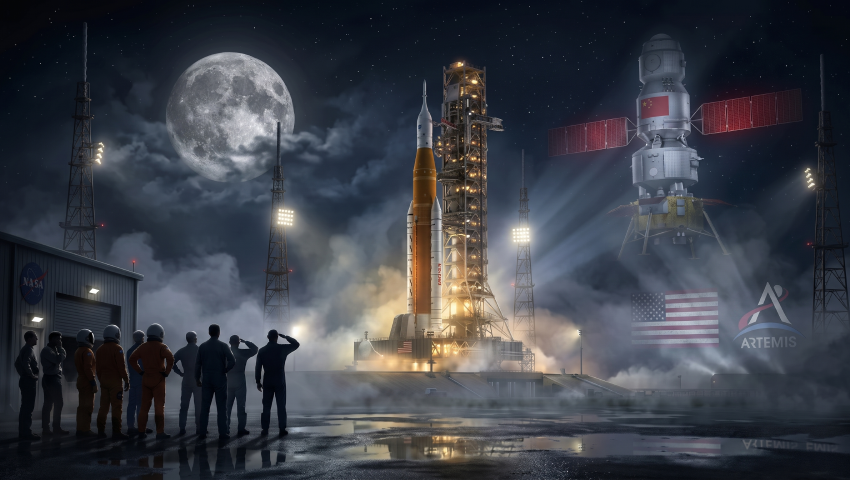
The space race is no longer just a matter of scientific exploration; it has once again become a fierce geopolitical competition. We recently discussed NASA’s intention to build a lunar nuclear reactor before its main international rivals. This was clearly emphasized by Sean Duffy, NASA’s acting administrator, who outlined a bold strategy to ensure the United States’ dominance in the new race to the Moon, a race in which China is the main competitor.
The goal is no longer simply to plant science, but to establish a sustainable human presence, and this requires solving a fundamental problem: energy. For this reason, the US space agency has received an ambitious directive: to launch and install a 100-kilowatt nuclear reactor on the lunar surface by 2030.
The idea of establishing a permanent base on the Moon faces a difficult physical reality for solar energy technology. The Moon rotates so slowly that every point on it experiences about two weeks of sunlight followed by two weeks of darkness and extreme cold. If most robotic rovers cannot survive a lunar night, powering a human base using solar panels alone is inconceivable. The situation is further complicated by the chosen destination: the lunar south pole region.
Part I: The Architectural Divergence of the New Lunar Era
1. The Strategic Inflection Point: February 2026
The exploration of the cislunar domain has officially transitioned from a period of aspirational rhetoric to one of rigid engineering reality. As of February 2026, the United States and the People’s Republic of China (PRC) are locked in a sophisticated, asymmetrical competition to return humans to the lunar surface. While often reduced to a simplistic “race” analogous to the Cold War rivalry of the 1960s, the current dynamic is fundamentally different in structure, motivation, and execution. It is a contest between two distinct philosophies of spaceflight: the American model of aggregated, multi-commercial partner complexity versus the Chinese model of state-directed, evolutionary pragmatism.
The stakes of this competition extend far beyond the planting of a flag. The first nation to establish a sustainable presence at the Lunar South Pole will effectively define the operational norms for the extraction of resources, specifically the water ice residing in Permanently Shadowed Regions (PSRs). This ice is the crude oil of the solar system—refinable into hydrogen and oxygen for rocket propellant—and controlling the prime extraction sites, such as the Shackleton or de Gerlache craters, represents a strategic advantage comparable to the control of terrestrial shipping lanes.
However, the American effort, codified in the Artemis program, faces a precarious future. Despite the successful uncrewed Artemis I mission in 2022, the program is currently besieging a series of compounding technical hurdles. The official timeline for Artemis III—the first crewed landing—has slipped repeatedly, with internal NASA assessments now evaluating “off-ramps” that would delay the landing well beyond 2027, potentially decoupling the human landing from the initial mission profile entirely. Conversely, China’s timeline for a 2030 landing appears increasingly robust, supported by a successful static fire of the Long March 10 heavy-lift rocket and the completion of integrated tests for the Lanyue lander.
This report offers an exhaustive technical and geopolitical autopsy of the current state of lunar exploration. It analyzes why NASA’s “aggregated architecture”—specifically its reliance on orbital cryogenic refueling and commercial services—has introduced critical path risks that are largely absent from China’s hypergolic, “Apollo-style” architecture. It further posits that the complexity of the Artemis critical path has created a window of opportunity for the PRC to achieve the first human landing of the 21st century, fundamentally altering the geopolitical balance of the cislunar sphere.
2. The Asymmetry of Purpose and Method
To understand the delay, one must first understand the architecture. The Artemis program was not designed solely to land on the Moon; it was designed to build a sustainable economic infrastructure for deep space, with Mars as the ultimate horizon. This requirement necessitated the development of reusable systems, orbital outposts (Gateway), and commercial partnerships that spread cost and risk but exponentially increased integration complexity.
In contrast, China’s manned lunar program (Project 921) is optimized for access. Its primary metric of success is the safe delivery of boots to the surface and their safe return. It utilizes expendable hardware, storable propellants, and a mission profile that minimizes the number of “miracle” technologies required to function on the first attempt.
The divergence is starkest in the propulsion strategies. NASA has bet the success of Artemis III on the ability of SpaceX to transfer thousands of tons of cryogenic methane and oxygen in microgravity—a feat never before accomplished at scale. China has bet its success on hypergolic propellants (hydrazine and nitrogen tetroxide), technology that has been mature since the Gemini program. This technical dichotomy is the primary driver of the shifting timelines and the source of the growing anxiety within the Western space community.
Part II: The Artemis Stagnation — Anatomy of the Delay
The narrative of Artemis in late 2025 is one of high-functioning individual components failing to coalesce into an integrated system. While the Space Launch System (SLS) has proven its capability as a super-heavy lifter, the elements required to interact with the lunar surface—the lander, the suits, and the thermal protection for return—remain immature.
1. The Orion Heat Shield: The Avcoat Anomaly
The most immediate threat to the near-term Artemis schedule, specifically the Artemis II crewed flyby (scheduled for April 2026) and the subsequent Artemis III landing, is the behavior of the Orion spacecraft’s thermal protection system (TPS).
✅ The Material Science of Failure
Orion utilizes an ablative heat shield composed of Avcoat, an epoxy novolac resin with special additives in a fiberglass honeycomb matrix. Designed to erode (ablate) during reentry, carrying heat away from the capsule, the shield must withstand temperatures up to 5,000°F (2,760°C) as the capsule hits the atmosphere at 25,000 mph (40,000 km/h).
During the Artemis I mission, post-flight analysis revealed a failure mode known as “spalling.” Instead of charring and eroding evenly, chunks of the charred material broke off, creating divots in the shield. While the capsule survived, the remaining thickness of the virgin material was less than the predicted safety margins. This behavior suggests that the thermal model failed to account for the specific interplay between the pore pressure of outgassing resins and the shear forces of the skip-entry trajectory used by Orion.
✅ The Waiver Decision and Future Risk
As of early 2026, NASA has made the controversial decision to fly Artemis II with the same heat shield design, rather than delaying the mission for a multi-year redesign. This decision is predicated on “risk acceptance” and trajectory modification—flying a less aggressive reentry profile to minimize thermal load.
However, this decision has cascaded risk onto Artemis III. If Artemis II exhibits similar spalling, NASA will face a binary choice: launch Artemis III with a known flaw that could be fatal during the higher-energy return from a landing mission, or ground the fleet for a redesign that would push the mission to 2028 or 2029. The “plan of record” for Artemis III includes a new heat shield formulation, but this formulation has never been flight-tested. The absence of a flight test for the new shield before the first landing attempt violates the “test like you fly” engineering doctrine, introducing a significant unknown into the mission assurance profile.
2. The Starship HLS: The Cryogenic Bottleneck
The decision to select SpaceX’s Starship as the Human Landing System (HLS) was a pivot toward maximizing landed mass and capability. However, it replaced the “single launch” architecture of Apollo with a “aggregated launch” architecture requiring unprecedented orbital logistics.
✅ The Physics of Zero-G Transfer
The Starship HLS must be refueled in Low Earth Orbit (LEO) before it can burn for the Moon. This requires a “depot” ship and a fleet of “tanker” ships to launch and transfer propellant. The physics of this transfer are non-trivial. In microgravity, liquids do not settle at the bottom of a tank; they float in globules. To pump fuel from a tanker to a depot, the spacecraft must apply “ullage thrust” (small acceleration) to settle the fuel, or utilize complex membrane/wicking systems.
Furthermore, the propellant—liquid methane and liquid oxygen—is cryogenic. Methane boils at -161.5°C, and oxygen at -183°C. In the vacuum of space, solar heating causes these fluids to boil off rapidly. For the Starship HLS to wait in lunar orbit (NRHO) for up to 90 days for the Orion crew, it requires active cryocoolers—essentially heavy, power-hungry refrigerators—to re-liquefy the boil-off. This technology, known as Zero Boil-off (ZBO), has been tested on small scales but never on a vehicle the size of Starship (1,200+ tons of propellant capacity).
✅ The Logistics of the Tanker Fleet
The sheer volume of propellant required has become a point of contention between SpaceX, NASA, and oversight bodies like the GAO. While SpaceX initially estimated a “low single digit” number of tanker flights, independent analyses and NASA OIG reports suggest the number is closer to 15-20 launches to fully fuel one HLS for a lunar landing
- Launch Cadence: To prevent excessive boil-off in the depot while waiting for the next tanker, the launches must occur in rapid succession—likely one every few days. This requires a launch cadence and ground support infrastructure at Starbase and Cape Canaveral that far exceeds current operational tempos.
- The Critical Path: Every single tanker launch is a potential failure point. If the 14th tanker fails to launch due to weather or mechanical issues, the fuel sitting in the depot continues to boil off, potentially jeopardizing the entire mission mass budget. This “chain link” vulnerability is the primary reason the GAO lists the HLS schedule as “unlikely” to meet the 2026/2027 targets.
3. The Spacesuit Crisis: The Fragility of Commercial Services
In a shift from the shuttle era, where NASA owned the spacesuit design, Artemis relies on “Exploration Extravehicular Activity Services” (xEVAS)—a commercial service contract. This model imploded in mid-2024 when Collins Aerospace, one of the two providers, withdrew from the contract, citing schedule unfeasibility.
This left Axiom Space as the sole provider for the moonwalking suits. While Axiom has made progress, passing Critical Design Reviews (CDR) and conducting thermal vacuum tests in late 2025 , the program has zero redundancy.
- Technical Challenges: The lunar South Pole presents a unique environment compared to the ISS. The dust is electrically charged and abrasive (like ground glass), and the lighting conditions create extreme thermal gradients—one side of the astronaut might be in direct sunlight (+120°C) while the other is in deep shadow (-170°C).
- Mobility: The suits must allow for walking, kneeling, and climbing in 1/6th gravity, a biomechanical challenge distinct from the “floating” EVA capability of the current EMU suits. Axiom’s “AxEMU” utilizes a new rear-entry design with advanced bearings, but any development hiccup here directly delays Artemis III, as you cannot land on the Moon without a suit to walk in.
4. The Gateway: Mass Growth and Schedule De-coupling
The Lunar Gateway, specifically the co-manifested Power and Propulsion Element (PPE) and Habitation and Logistics Outpost (HALO), was intended to be the aggregation point for Artemis missions. However, mass growth has threatened this timeline.
Audits in late 2024/2025 revealed that the combined mass of the PPE and HALO exceeded the lift capacity of the Falcon Heavy rocket by approximately 1,300 kg. Weight reduction programs are notoriously slow and expensive. Furthermore, the PPE utilizes solar electric propulsion (ion engines) to spiral out to the Moon—a process that takes nearly a year. Even if launched in 2027, the Gateway would likely not be in position until 2028 or 2029.
Recognizing this, NASA has essentially de-coupled Gateway from Artemis III, planning for a direct docking between Orion and Starship HLS in orbit. While this saves the schedule, it leaves the Gateway as a “solution looking for a problem” in the early phase of the campaign, further complicating the political justification for the program’s expense.
Part III: The Red Moon Rising — China’s Technical Trajectory
While the U.S. struggles with the integration of its complex architecture, the People’s Republic of China is executing a methodical, linearized strategy. The “Mengzhou-Lanyue” architecture is less capable in terms of total landed mass than Starship, but it is significantly more robust in terms of mission assurance and timeline credibility.
1. The Long March 10 (CZ-10): The Workhorse
The Long March 10 is the linchpin of China’s lunar ambitions. It represents a pragmatic engineering choice: rather than developing a radically new propulsion system (like SpaceX’s full-flow staged combustion Raptor), China scaled up its existing, proven technology.
✅ Comparison of Heavy Lift Capabilities
The heavy-lift launch vehicle landscape features distinct design philosophies and capabilities. The SLS Block 1B (USA) focuses on crew transport, particularly for Orion missions, with a LEO payload capacity of around 105 tons and a TLI capacity near 42 tons, powered by hydrolox RS-25 engines. It is fully expendable, reflecting NASA’s priority on proven reliability over reusability, and is currently operational in its Block 1 configuration.
Starship (USA) aims for maximum versatility, serving as both a cargo and lander platform. Its LEO capacity ranges from 100 to 150 tons, with interplanetary missions requiring in-orbit refueling. Powered by methalox Raptor engines, Starship is designed to be fully reusable, emphasizing rapid turnaround and cost efficiency. It is presently undergoing flight testing.
China’s Long March 10 is tailored for crewed missions and lander transport, with LEO capability of about 70 tons and a TLI capacity of ~27 tons. Its propulsion combines kerolox YF-100K engines for the first stage with hydrolox upper stages, and partial reusability is planned via first-stage recovery. The system is still in static fire testing as development continues.
Overall, Starship leads in payload and reusability, SLS Block 1B emphasizes crew mission reliability, and Long March 10 balances medium-lift performance with planned reusability.
The CZ-10 uses the YF-100K engine, an oxidizer-rich staged combustion cycle engine burning kerosene and liquid oxygen. This engine is an upgraded version of the YF-100 used on the Long March 5, which has a high reliability record. By clustering these engines, China achieves the necessary thrust without the development risk of new engine cycles.
The rocket’s lift capacity (27 tons to TLI) is insufficient to launch a lander and crew together (which requires ~45-50 tons). Therefore, China employs a two-launch architecture:
- Launch 1: The Lanyue Lander stack.
- Launch 2: The Mengzhou Crew Spacecraft with astronauts. The two vehicles rendezvous in lunar orbit. This approach doubles the launch risk (two rockets must go right) but eliminates the need for a super-heavy lifter on the scale of Saturn V or Starship, allowing China to use a rocket that is “only” the size of a Falcon Heavy.
2. The Lanyue Lander: The Hypergolic Advantage
The Lanyue (“Embracing the Moon”) lander is the specific technical element that gives China a schedule advantage. Unlike Starship, which requires cryogenic management, Lanyue uses hypergolic propellants.
✅ The “Crasher Stage” Architecture
The lander design incorporates a distinct propulsion module (often called a “crasher stage”) and a landing/ascent module.
- Descent: The propulsion module performs the majority of the braking burn from lunar orbit down to the near-surface. It then separates and crashes.
- Landing: The crewed module, now significantly lighter, performs the final hover and soft touchdown using its own engines.
- Ascent: The same engines on the crewed module lift it back to orbit to dock with Mengzhou.
✅ Why Hypergolics Matter
Hypergolic fuels (hydrazine/NTO) ignite on contact and are stable liquids at room temperature. This means:
- No Boil-off: The Lanyue lander can sit in lunar orbit for weeks or months waiting for the crew without losing fuel.
- Reliability: The engines are simple. There are no turbopumps (usually) or complex igniters to fail. The YF-75D/E engines typically used for upper stages are extremely mature.
- Simplicity: No sunshields, no cryocoolers, no orbital depots. The lander launches fueled and stays fueled.
The successful integrated landing/takeoff test in August 2025 verified the GNC (Guidance, Navigation, and Control) algorithms for this specific architecture. This test suggests that the critical software and propulsion integration is already at a high Technology Readiness Level (TRL).
3. The Mengzhou Spacecraft
The Mengzhou (“Dream Vessel”) is China’s answer to Orion. It is a modular spacecraft capable of carrying up to 7 astronauts (though likely 3-4 for lunar missions).
- Safety: It features a detachable service module and a reentry module designed for skip-reentry, similar to Orion, to manage the high heat of lunar return.
- Testing: Boilerplate versions have already flown (2020), and full-up integrated escape tests were conducted in 2025.
- Comparison: While Orion is heavier and has more internal volume, Mengzhou appears perfectly sized for the specific mission of shuttling crew from Earth to the Lunar Orbit Rendezvous point. It avoids the “gold-plating” that has plagued Orion’s development.
Part IV: The Geopolitical Battlefield — Law, Alliances, and Territory
The technical race is underpinned by a fierce diplomatic contest to define the rules of the road for the 21st century.
1. The Wolf Amendment and the Great Bifurcation
Since 2011, the “Wolf Amendment” has legally prohibited NASA and the White House Office of Science and Technology Policy (OSTP) from using federal funds to cooperate with the Chinese government. While intended to prevent technology transfer and espionage, this legislation has had the secondary effect of forcing China to develop a fully independent, parallel space architecture.
This separation has crystallized into two competing alliance blocks:
- The Artemis Accords (USA-led): A set of non-binding principles grounded in the Outer Space Treaty of 1967. It emphasizes transparency, interoperability, and the right to extract and use space resources (Section 10). Signatories include traditional allies (ESA, JAXA, Canada) and new partners (India, Brazil).
- The International Lunar Research Station (ILRS) (China-led): A concrete project to build a base. Partners include Russia (Roscosmos), Venezuela, Pakistan, Egypt, and potentially others in the Global South. China uses the ILRS as a diplomatic tool, offering “turnkey” access to space for developing nations in exchange for political alignment, mirroring its Belt and Road Initiative strategy on Earth.
2. The “Land Grab” Risk at the South Pole
The focus on the Lunar South Pole is driven by resources. The craters here—Shackleton, Haworth, Faustini, Nobile—contain water ice. However, the regions that are safe to land (flat, illuminated) and close to the ice (dark, cold) are rare. These “Peaks of Eternal Light” are small, often only a few kilometers across.
The Conflict Scenario: Both Artemis III and China’s Chang’e-7/8 (robotic precursors) and eventual crewed missions have identified the same landing sites.
- If China lands a rover or a crewed mission at a prime site near Shackleton Crater, they could effectively establish a “safety zone” around their operations.
- Under the pretext of safety (preventing plume damage), they could demand that U.S. assets stay at a distance.
- Since the best sites are small, this could effectively lock the U.S. out of the most valuable real estate without China ever formally claiming “sovereignty” (which is banned by the Outer Space Treaty).
- Administrator Bill Nelson has explicitly warned of this scenario, stating, “It is not beyond the realm of possibility that they say, ‘Keep out, we’re here, this is our territory'”.
3. The Role of Russia
Russia is a junior partner in the ILRS. Its space program, Roscosmos, has been severely degraded by budget cuts and the loss of international commercial launch revenue following the invasion of Ukraine. However, Russia possesses deep expertise in automated docking and long-duration life support—knowledge that aids China. Yet, the partnership is increasingly unequal, with China providing the capital and the vision.
Part V: The Invisible Risks — Scientific Fratricide
Beyond the political posturing, there is a scientific tragedy unfolding. The very act of landing to study the “pristine” lunar ice may destroy it.
1. The Plume Contamination Problem
When a spacecraft lands on the Moon, its engines blast the surface with high-velocity gas.
- Starship HLS: A landing burns tons of methane (CH4) and oxygen. Simulation models show that the exhaust plume expands rapidly in the vacuum, wrapping around the Moon. Approximately 20% of the emitted water vapor and carbon compounds will settle into the cold traps at the poles.
- Scientific Impact: If a scientist samples the ice at the South Pole and finds organic molecules (carbon-hydrogen bonds), they will have to determine: “Is this evidence of ancient prebiotic chemistry delivered by comets, or is this unburned methane from the Starship that landed 100 km away?” The “noise” introduced by the lander could overwhelm the “signal” of the native ice.
2. Hypergolic Markers
China’s Lanyue lander poses a different contamination risk. Hydrazine (N2H4) and Nitrogen Tetroxide (N2O4) leave distinct nitrogen-rich chemical signatures. While the mass of the plume is smaller than Starship’s, the chemistry is more exotic and less likely to be confused with water ice, but potentially more reactive with the surface regolith.
The lack of coordination due to the Wolf Amendment means there is no mechanism for the U.S. and China to agree on “pristine preservation zones” where landing is prohibited to protect scientific baselines.
Part VI: Timeline Analysis and the “Beat Them To It” Verdict
To answer the core question—”Will China beat them to it?”—we must analyze the critical paths of both nations using a probabilistic approach.
1. The Artemis Critical Path (The “Optimistic” vs “Realist” View)
- Official Target: Artemis III landing in mid-2027.
- Realist Assessment:
- HLS: Requires ~15 tanker launches. SpaceX has not yet demonstrated ship-to-ship transfer. Even with a successful demo in 2026, the operational cadence required suggests a readiness date of 2028-2029.
- Heat Shield: If Artemis II (2026) shows spalling, a redesign takes 18-24 months. Readiness: 2029.
- Suits: Axiom is progressing, but single-string procurement is risky. Readiness: 2027.
- Projected Artemis III Landing:Late 2028 to Mid-2029.
2. The China Critical Path
- Official Target: Crewed landing by 2030.
- Realist Assessment:
- Rocket: CZ-10 static fire complete (2025). Maiden flight likely 2027. Crewed flight 2028/2029.
- Lander: Integrated tests complete (2025). Uncrewed demo (Chang’e-8 era) likely 2028.
- Simplicity Bonus: The lack of orbital refueling eliminates the biggest variable.
- Projected Chinese Landing:2029-2030.
3. The Intersection: The Danger Zone
The timelines are converging. An Artemis landing in 2029 and a Chinese landing in 2030 are statistically indistinguishable given the error bars of aerospace development.
The “Beat Them To It” Verdict: China has a High Probability of beating the current definition of Artemis III if Artemis III slips past 2028. However, NASA retains a Strategic Advantage in capability. If Starship works, it delivers 100 tons to the surface. Lanyue delivers 2 crew and a small rover. The U.S. may lose the race to be first back, but still win the race to stay sustainably.
The Pivot Risk: There is a significant chance that NASA, facing delays, will de-scope Artemis III.
- Option A: Artemis III becomes a Gateway mission (no landing).
- Option B: Artemis III becomes a LEO Starship docking test. In this scenario, the “landing” moves to Artemis IV (2030+). This would virtually guarantee that China lands first, handing Beijing a massive propaganda victory and validating their “slow and steady” authoritarian model over the “messy” democratic commercial model.
4. Strategic Recommendations for the U.S.
- Prioritize the Propellant Transfer Demo: This is the single most important test in the entire Artemis architecture. NASA must ensure SpaceX has the resources and regulatory clearance to execute this ASAP.
- Develop a “Plan B” Lander? The prompt suggests sticking to the analysis, but logically, the reliance on a single HLS provider is the critical weakness. Re-introducing competition (Blue Origin’s Blue Moon) is underway for Artemis V, but it is too late for Artemis III.
- Diplomatic Offense: The U.S. must aggressively expand the Artemis Accords to include more non-aligned nations to prevent the ILRS from becoming the de facto “Global South” space program.
Conclusion
The delay of NASA’s return to the Moon is not a result of incompetence, but of ambition. By choosing an architecture that requires orbital refueling, cryogenic storage, and commercial reusability, the United States accepted a high degree of technical risk in exchange for a potentially revolutionary capability.
China, conversely, has chosen a path of low technical risk and high schedule certainty. Their hypergolic, dual-launch architecture is a modern echo of Apollo—proven, storable, and simpler.
As of 2026, the race is a dead heat. The “hare” (SpaceX/Starship) is napping at the refueling depot, while the “tortoise” (China/Long March) is plodding methodically toward the finish line. Unless the United States can resolve the specific physics challenges of cryogenic fluid management and the material science challenges of the Orion heat shield within the next 24 months, the red flag of the PRC is likely to fly over the Shackleton Crater before the Stars and Stripes returns.
The next two years—defined by the success or failure of the Starship tanker tests and the Artemis II reentry—will determine the leadership of the cislunar domain for the next century.
Appendix: Comparative Data
1. Moon Rocket Comparison
The leading moon-bound rockets each follow distinct strategies tailored to their mission profiles. The SLS Block 1B (USA) is designed for crewed Orion missions, using a hydrogen/oxygen core and two stages with boosters. It generates roughly 8.8 million lbf of liftoff thrust and can deliver about 42 tons to TLI, currently operational and focused on reliability for human spaceflight.
China’s Long March 10 (CZ-10) also targets crew and lander missions, featuring three stages plus boosters fueled by kerosene/oxygen. With 5.8 million lbf of liftoff thrust, it can send ~27 tons to TLI. As of 2026, it remains in static fire testing, reflecting ongoing development of China’s lunar ambitions.
The Starship / Super Heavy (USA, commercial) prioritizes heavy cargo and lander missions with a fully reusable approach. Using methane/oxygen, it produces an enormous ~16 million lbf of thrust and, when refueled in orbit, can deliver 100+ tons to TLI, making it the most ambitious in terms of payload capacity. It is currently undergoing flight testing, with rapid reusability as a key differentiator.
In summary, SLS Block 1B emphasizes human-rated reliability, Long March 10 focuses on crew access with incremental development, and Starship pushes the envelope on payload and reusability for lunar and beyond-lunar missions.
2. Lander Architecture
The lunar landers under development reveal contrasting design philosophies. The Starship HLS for Artemis III relies on cryogenic methane/LOX propellant, requiring refueling from a LEO depot before descent. Its single-stage architecture from NRHO (Near-Rectilinear Halo Orbit) allows a higher crew capacity of 2–4 astronauts, with theoretical reusability, though it carries high boil-off risk due to the cryogenic fuels needing active cooling.
In contrast, China’s Lanyue lander for the Mengzhou mission uses hypergolic propellants (N2O4/MMH), which are storable at ambient temperatures and thus pose zero boil-off risk. It has a two-stage architecture separating propulsion and landing, supports 2 crew members, and is expendable, prioritizing mission simplicity and reliability over reuse.
Essentially, Starship HLS emphasizes high capacity and reusability at the cost of fuel management complexity, whereas Lanyue emphasizes operational simplicity, thermal stability, and mission reliability, albeit with a smaller crew and no reuse potential.