


 by Simo Naboussi
 Creativity is defined as the ability to generate new and useful ideas. It represents one of humanity's most remarkable capabilities and is evident in our thoughts and behaviors. In the age of automation, machine learning, and artificial intelligence (AI), companies need more than ever creative employees who can tackle challenges requiring innovative approaches, generate new ideas to advance society, and are unafraid to question traditional methods.
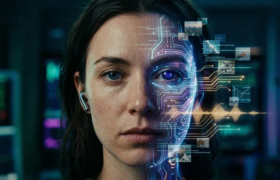
Advances in AI have begun to transform creative processes and challenge our understanding of "creative thinking." However, while AI systems offer numerous advantages as intelligent and efficient assistants, we believe they are also capable of inspiring human creativity.
The integration of AI into the creative process represents a paradigmatic shift in how human beings generate, refine, and execute ideas. No longer merely a tool for automation or efficiency, Generative AI (GenAI) has evolved into a "cybernetic teammate" capable of participating in the most intimate stages of creation: the overcoming of the blank page, the divergence of initial possibilities, and the convergence of final solutions. To understand how AI accelerates ideation, one must first deconstruct the cognitive mechanisms of creativity itself and observe how algorithmic intervention alters the topology of human thought.
Creativity is scientifically understood not as a singular lightning bolt of inspiration, but as a dynamic oscillation between two distinct modes of thought: divergent thinking (the generation of multiple, novel possibilities) and convergent thinking (the critical selection and refinement of a single solution). Recent empirical evidence suggests that AI assistants intervene effectively in both modes, but through fundamentally different mechanisms than human cognition.
In the realm of divergent thinking, the human mind is often limited by biological constraints. We rely on a "salience network"—a neural pathway that prioritizes the most obvious, familiar, and energy-efficient connections. When a human brainstorms, they are retrieving information from a limited biological database, heavily biased by recent experiences and domain expertise. This often leads to cognitive fixation, where the thinker becomes trapped in a "local maximum," unable to see solutions that lie outside their immediate frame of reference.
Contrast this with the architecture of a Large Language Model (LLM). These systems operate on a statistical recombination of training data that encompasses a near-total corpus of digitized human knowledge. Research indicates that GenAI models, such as GPT-4o and Claude, consistently outperform human participants in standard divergent thinking tasks, such as the Alternate Uses Task (AUT). in these assessments, where participants are tasked with generating novel uses for common objects like a brick or a paperclip, AI demonstrates superior "fluency" (the sheer number of ideas) and "originality" (the statistical rarity of the ideas).
However, the nature of this "creativity" is distinct. The AI does not "imagine" in the human sense; it calculates semantic proximity. It functions as a Stochastic Resonator, injecting noise and variability into the brainstorming process to dislodge human thinkers from their cognitive ruts. This capability addresses a critical bottleneck in human ideation: the path of least resistance. By offering "moonshot" ideas—concepts that are statistically improbable yet semantically valid—AI expands the "semantic breadth" of the session, allowing human teams to explore a solution space that is orders of magnitude larger than what could be achieved through biological memory alone.
The acceleration of convergent thinking is equally profound but operates through a different psychological mechanism. Convergent thinking requires executive control, judgment, and the inhibition of irrelevant information. This is a high-cognitive-load activity. When a human attempts to be both the generator (divergent) and the judge (convergent) simultaneously, they experience cognitive overload. AI allows for a separation of roles. The human can offload the "drafting" (the generator role) to the AI, reserving their mental energy for the "crafting" (the editor role). This shift from "Lone Genius" to "Editor-in-Chief" is central to the acceleration of the workflow.
Here’s a clear breakdown of how AI can augment human cognition across different modes of thinking:
In short, AI acts as a cognitive force multiplier, enhancing creativity, problem-solving, and innovation by complementing human strengths while mitigating limitations.
One of the most persistent barriers to innovation is the "Einstellung Effect," or the tendency to approach a problem with a preconceived mindset based on past success. Expert intuition, while valuable, can become a prison. A seasoned engineer knows intuitively what "won't work," and thus may subconsciously filter out viable innovations before they are even fully articulated.
AI acts as a powerful antidote to this fixation through the mechanism of Lateral Injection. By utilizing high "temperature" settings—a parameter that controls the randomness of the model's output—teams can force the AI to make "hallucinatory" connections that a disciplined human mind would reject. For example, in the study of circular economy business models, human participants tended to generate ideas that were novel but disconnected from technical reality, or feasible but derivative. The AI, however, was able to bridge disparate domains—connecting "foundry dust" with "interlocking brick technology"—to propose solutions that were both technically grounded and commercially novel.
This phenomenon creates a "Cybernetic Loop." The human provides the intent (e.g., "Solve the plastic waste crisis"), the AI generates a "Visual/Semantic Soup" of thousands of potential mechanisms (mycelium packaging, enzymatic recycling, plasma gasification), and the human then applies their "Taste" to select the most promising avenues. This loop turns the ideation process from a scarcity model (struggling to find one good idea) to an abundance model (struggling to filter a thousand good ideas). The limiting factor shifts from generation to curation.
Furthermore, AI aids in Analogical Reasoning. Innovation often comes from borrowing a solution from one industry and applying it to another (e.g., how the printing press inspired the Ford assembly line). Humans are generally poor at retrieving analogies from outside their specific domain expertise. An LLM, having "read" the literature of every domain, can instantly retrieve cross-domain analogies. A prompt such as "How would a marine biologist solve this supply chain problem?" can yield insights about "swarm intelligence" or "nutrient cycling" that a logistics manager would never independently derive.
The "Blank Page" is more than a metaphor; it is a psychological state of high anxiety and low dopamine, often referred to as Blank Page Syndrome. The terror of the infinite—the pressure to manifest perfection from nothing—triggers the amygdala, leading to a "freeze" response that blocks the prefrontal cortex's creative faculties. This is compounded by "Imposter Syndrome" and perfectionism, where the creator fears that their output will not meet the social or professional standards required.
AI assistants dismantle this barrier through the mechanism of the "Bad Draft" or "Draft Zero." It is psychologically easier for a human to correct a mistake than to originate a truth. By asking an AI to "generate a rough outline" or "write a terrible first draft," the creator bypasses the initial terror of creation. The AI provides a "Straw Man"—an artifact that exists in the world, however imperfect. This shifts the user's cognitive state from "Creation" (high anxiety) to "Correction" (high competency). The creator can look at the AI's output and say, "No, that's wrong," which immediately clarifies what is "right." The act of correction acts as a propellant, launching the creator into the work.
This acceleration facilitates entry into the Flow State, defined by Csikszentmihalyi as a state of deep absorption where the challenge of a task perfectly matches one's skills. In complex creative work, "friction" often breaks flow—the friction of not knowing a specific fact, of struggling with syntax, or of hitting a logic gap. AI removes these micro-frictions. It acts as a "Cognitive Scaffold," supporting the creator's executive function. When a writer gets stuck on a transition, or a designer struggles with a specific texture, the AI provides an immediate bridge, allowing the human to maintain their "macro" focus on the narrative or design architecture without getting bogged down in the "micro" execution.
The result is Scaffolded Creativity. The human provides the "seed" or intent, the AI generates the "structure," and the human refines the "surface." This loop—Seed, Generate, Refine—can happen in seconds, accelerating the iteration cycle by orders of magnitude. The "time-to-first-idea" is reduced from days to minutes, allowing for significantly more cycles of refinement within a given project timeline.
As AI transitions from a novelty to a core business utility, ad-hoc usage must be replaced by robust theoretical frameworks. "Prompting" is not a strategy. To reliably accelerate idea generation, organizations must adopt structured models that define the roles, stages, and interaction dynamics between human and machine. This section explores the Human-AI Co-Creative Design Process (HAI-CDP) and the evolving concept of Creative Agency.
The Human-AI Co-Creative Design Process (HAI-CDP) is an adaptation of the classic "Double Diamond" design methodology (Discover, Define, Develop, Deliver), specifically re-engineered for the generative AI era. It maps distinct AI capabilities to each phase of the creative lifecycle, transforming the workflow from a linear progression to a recursive dialogue.
Phase 1: Concept Definition (Discover & Define) The early stage of innovation is characterized by ambiguity. "We need a new product" is too vague for either human or machine. In this phase, AI acts as a Cognitive Partner. Unlike a search engine, an LLM can engage in a dialogue to "interview" the stakeholder. It asks clarifying questions ("Who is the target audience?", "What are the technical constraints?", "Is the priority cost or sustainability?") that force the human to articulate their tacit knowledge. This process of "Conversational Framing" helps to synthesize vast amounts of background data—market reports, user reviews, competitor analysis—into a coherent "Problem Statement." The act of crafting a prompt for the AI forces the human to define the essence of the idea; one cannot prompt for what one cannot define.
Phase 2: Visual & Semantic Exploration (Develop - Divergent) Once the problem is defined, the goal shifts to quantity. This is the Stochastic Generation phase. AI tools like Midjourney or enterprise-grade text generators act as "concept engines," generating hundreds of variations in the time a human might sketch one. This creates a "Visual/Semantic Soup"—a raw collection of possibilities that visualizes the breadth of the solution space. The AI is encouraged to hallucinate, to merge concepts (e.g., "Cyberpunk Art Deco Toaster"), and to explore the edges of the bell curve. This phase is crucial for overcoming the "Design Fixation" that often traps human teams in the first viable idea they encounter.
Phase 3: Design Development (Develop - Convergent) The human re-enters the loop as the primary agent, selecting and refining. The AI shifts from a generator to an Instrumental Tool. The interaction model becomes "Iterative Refinement" or "In-painting." The human acts as a "DJ," mixing and matching elements from the AI's divergent output—taking the color palette from Image A and the structural integrity of Image B. The AI aids in constraint satisfaction, checking the wild ideas against the realities of budget, physics, or brand guidelines. This is where the "Editor" mindset is most critical.
Phase 4: Implementation (Deliver) The final stage uses AI as an Automator. The focus is on translation—turning a sketch into a 3D model, a bulleted list into a polished report, or a storyboard into a video animatic. Emerging technologies such as diffusion-based image-to-3D systems and neural rendering frameworks streamline the handoff between ideation and production, effectively collapsing the "Execution Gap" that often stalls projects.
As AI takes on more of the "creative" work, we face the Agency Paradox: If the AI generates the idea, is it mine? This question is central to the motivation and psychological well-being of the creative workforce. Research differentiates between two primary modes of interaction: Augmentation and Automation.
Psychological Ownership flows from two sources: control and investment of effort. When AI is used for Augmentation (e.g., "Give me 10 ideas for a title, and I will choose and edit one"), perceived ownership remains high. The user feels the AI is an extension of their own mind, a "prosthetic imagination." However, when AI is used for Automation (e.g., "Write this article for me"), ownership collapses. The user feels like a passive observer or a "button pusher." This leads to a Role Identity Crisis, where the professional no longer identifies as a "Writer" or "Designer" but as a "Prompt Feeder."
To maintain high agency, users employ specific adaptive strategies:
We can categorize the maturity of AI integration into four levels, as proposed by recent research in human-computer co-creativity :
One of the most potent applications of AI in ideation is found in the realm of Search Engine Optimization (SEO) and Content Strategy. The traditional model of "Keyword Research"—finding high-volume words and stuffing them into text—is obsolete. AI has ushered in the era of Entity-Based Ideation, where ideas are generated based on the semantic relationships between concepts.
Search engines like Google have moved beyond matching strings of text to understanding Entities—people, places, things, and concepts—and the relationships between them. This is the Knowledge Graph. AI tools like ChatGPT, MarketMuse, and specialized SEO agents function by mapping these semantic relationships instantly.
In the past, a content strategist might brainstorm topics by guessing what users might type. Now, the process is inverted. The AI generates a Topical Map. If the seed topic is "Sustainable Fashion," the AI does not just return keywords like "organic cotton." It builds a semantic cluster: "Circular Economy" -> "Textile Recycling" -> "Supply Chain Transparency" -> "B-Corp Certification." It understands that "Patagonia" is an entity related to "Corporate Responsibility" and "Fleece," while "Polyester" is related to "Microplastics".
This shifts ideation from a "guessing game" to an architectural discipline. The content strategist becomes an Information Architect, deciding which branches of the knowledge graph the brand has the authority to occupy. The ideation question shifts from "What should I write today?" to "What entity is missing from my semantic graph?".
AI excels at identifying the "negative space" in a content strategy—the ideas that aren't there. Through Gap Analysis, AI tools can compare a brand's content library against the entirety of the web's knowledge on a specific topic.
The Semantic Ideation Workflow:
This methodology transforms SEO from a traffic-chasing exercise into a genuine innovation engine. The ideas generated are not just "search-friendly"; they are intellectually additive to the global conversation.
Looking forward, the nature of discovery is shifting from "Search" (user seeks information) to "Agents" (software acts on behalf of the user). In the Agentic Web, AI agents will traverse the web to find answers, products, and solutions. Ideation must therefore optimize for Machine Readability and API Compatibility.
This creates a new category of ideation: Structured Data Ideation. Content ideas must be structured as Schema Markup, bulleted lists, and clear logical propositions that an AI agent can easily parse and serve to a user. The "creative" act involves designing data structures that answer complex queries. For example, a recipe blog isn't just about a story of cooking; it's about ideating a JSON-LD structure that allows an AI agent to read the ingredients and order them from a grocery store automatically.
The implications for 2026 are profound. Brands will need to "ideate" not just for human eyes, but for the "Agentic Crawlers" that represent the new gatekeepers of attention. This requires a fusion of creative storytelling and technical rigor—a true "Hybrid Mind" approach.
The acceleration of idea generation manifests differently across industries, shaped by the specific "media" of those sectors—whether that be code, pixels, words, or industrial materials. This section analyzes three distinct transformations.
In the media sector, AI is shifting the role of the creator towards a "Showrunner" model—someone who oversees a vast, semi-automated production engine. The barrier to entry for high-fidelity production has collapsed, meaning ideation is no longer constrained by budget, but by imagination.
New platforms are emerging that stream "Micro-Dramas"—ultra-short, high-engagement episodes tailored to mobile viewing. These platforms require a volume of writing that no human team can sustain. AI workflows are used to generate the "Beat Sheet" (plot points) based on successful narrative tropes (e.g., "The Secret Billionaire," "The Revenge Plot"). Human writers then flesh out the dialogue and emotional beats. This industrializes storytelling, turning the "Idea" from a precious, singular artifact into a commodity. The value shifts to the Execution and the Twist—the unique element that subverts the trope.
Furthermore, AI enables Multilingual Ideation. Creators can now ideate for global audiences simultaneously. The EBU (European Broadcasting Union) case studies highlight how public service media use AI to adapt stories for different cultures. This is not just translation; it is Cultural Transcreation. An AI can suggest adaptations during the scripting phase: "In the German version, make this character more punctual; in the Italian version, emphasize their family loyalty." This allows for "Global Ideation" at the very inception of the project.
Case Study: Eurovision 2025 The Eurovision Song Contest utilized AI-backed workflows to manage the immense complexity of live production. AI did not write the songs, but it managed the "Ideation of Logistics." It simulated lighting cues, camera angles, and stage transitions, allowing directors to "ideate" the visual show in a virtual sandbox before a single piece of equipment was moved. This "Pre-visualization" capability saves millions in production costs and allows for more risk-taking in the creative design.
In physical product design, AI is facilitating a move from CAD (Computer-Aided Design) to Generative Design. In traditional CAD, the engineer draws the shape. In Generative Design, the engineer inputs the goals and constraints, and the AI "grows" the solution.
This represents a shift to Goal-Directed Ideation. The input is a problem statement: "Design a bracket that holds 50kg, fits in this volume, and minimizes weight." The AI generates thousands of permutations, often producing organic, bone-like structures that no human would sculpt because they are unintuitive to the human mind. The human engineer then selects the best option based on manufacturability and aesthetics.
Case Study: BMW Predictive Maintenance While primarily an operational case, BMW's use of AI to monitor 47 micro-signals (vibration, sound, temperature) represents a shift in problem-solving ideation. The AI identifies patterns of failure that humans couldn't conceive of. It effectively "ideates" the maintenance schedule before the machine breaks. This is Inverted Ideation: imagining the problem to prevent it. The system predicts machine failures 3–5 days in advance with 92% accuracy, leading to a 25% drop in unplanned downtime.
Case Study: General Motors GM used generative design to reimagine a simple seatbelt bracket. The AI generated over 100 design alternatives. The final design was a single part (replacing eight separate parts), was 40% lighter, and 20% stronger. This level of optimization is mathematically impossible for a human designer to achieve through manual iteration alone.
Marketing ideation has historically been about the "Big Campaign"—one idea that appeals to millions. Now, it is about the "Infinite Nudge"—millions of ideas, each appealing to one person.
Dynamic Creative Optimization (DCO) AI generates infinite variations of ad copy, imagery, and offers. The "ideation" happens in real-time based on user data. A user visiting a travel site might see a banner ad generated specifically for them. The AI chooses the image (Beach vs. Mountain), the copy (Relaxing vs. Adventurous), and the offer. The "Idea" is not a static poster; the "Idea" is the Algorithm that matches content to context. The creative director doesn't approve the ad; they approve the rules of the ad generator.
Case Study: "My Club Daily" This sports personalization project uses AI to deliver tailored football updates. The "idea" of the content is unique to every single user. The AI decides what is relevant to this fan at this moment, effectively automating the editorial ideation process. If a fan follows a specific player, their update focuses on that player's stats; if they are interested in league standings, the update focuses on the math. The system generates thousands of unique narratives daily.
Emotional Copywriting and Affective Ideation Contrary to the belief that AI is robotic, tools like Jasper and specialized "Emotional AI" prompts help marketers tap into specific psychological triggers (Fear, Relief, Empowerment). By asking AI to "rewrite this for a stressed mother who needs relief," the system adjusts syntax and vocabulary to maximize empathy. This is Affective Ideation. Research suggests that emotionally intelligent copy—addressing objections and validating feelings—drives significantly higher engagement. AI scales this emotional intelligence, allowing brands to speak to the "reptilian brain" of the consumer at a scale previously impossible.
The acceleration of ideation is not without its costs. Innovation is not just a process; it is an emotional journey. When AI intervenes in the "sacred" realm of creativity, it triggers deep psychological responses in the workforce that organizations must manage to prevent burnout and disengagement.
Creative Displacement Anxiety (CDA) is a newly identified psychological phenomenon defined as the existential dread that arises when an algorithm performs a task that a human considers central to their identity. It is rooted in the collapse of the Effort Heuristic—the cognitive bias where we value things based on how hard they were to make. When AI generates a masterpiece in seconds, the "value" of creativity seems to plummet, leading to a crisis of professional self-esteem.
Symptoms include resistance to adoption, "sabotaging" the AI (intentionally using it poorly to prove it fails), or a loss of motivation. To mitigate this, leaders must reframe the narrative of competence. The skill is no longer Generation (drawing, typing); the skill is Synthesis and Vision. The human is the Architect; the AI is the Builder. We do not disrespect the architect because they didn't lay the bricks themselves. Organizations must celebrate the "Director" mindset over the "Operator" mindset.
A subtle danger is the Illusion of Control. Users may feel they are "collaborating," but if they uncritically accept AI suggestions, they are actually being "steered" by the model's training data. This leads to Homogenization or Mean Reversion. Because AI models are trained on the "average" of the internet, their default output tends toward the mediocre, the cliché, and the safe. If every agency uses GPT-4 to brainstorm "Sustainability Campaigns," they will all get the same 10 ideas.
To combat this, teams must focus on "Burstiness" and "Temperature." Human operators must be trained to force the AI into "High Entropy" states. They must inject Proprietary Data (unique human insights, personal anecdotes, non-digitized knowledge) into the prompt to steer the AI away from the generic mean. The human must be the Source of Variance. Without this active disruption, AI-assisted ideation becomes an echo chamber of the status quo.
To foster a successful hybrid culture, organizations must build Psychological Safety. If employees believe AI is there to replace them, they will hide their best ideas or hoard their knowledge. Management must explicitly state that AI is a support system and that the human is always accountable for the final output. This policy of "Human-in-the-Loop" restores the sense of agency and responsibility.
Furthermore, organizations must invest in AI Literacy. This goes beyond "how to use ChatGPT." It is "how to think with AI." It involves understanding the probabilistic nature of the models—that they are predicting the next token, not telling the truth. It involves understanding the biases inherent in the training data. An AI-literate workforce knows when to trust the machine and, more importantly, when to ignore it. They understand that AI is a tool for divergence (generating options), not necessarily truth (generating facts).
As we look toward 2026 and beyond, the role of AI in ideation will continue to evolve. We are moving from the "Chatbot Era" (passive tools) to the "Agentic Era" (proactive partners).
The era of "One Giant Model to Rule Them All" is ending. We will see a proliferation of Small Language Models (SLMs) trained on specific company data. A "Disney Ideation Bot" trained on 100 years of Disney scripts will generate ideas that "feel" uniquely like Disney. A "Nike Ideation Bot" will generate ideas that align with Nike's athletic ethos.
This shift turns data into a competitive moat. The "Idea" is no longer the output; the "Idea" is the Dataset you train your model on. Your proprietary data becomes your engine of creativity. This allows for Differentiation at Scale. Companies will stop using generic AI that produces generic ideas and start using bespoke AI that amplifies their unique cultural and intellectual DNA.
The shift in Search (SGE - Search Generative Experience) means that "ideation" for content creators is no longer about "getting clicks" but about "winning the answer." Content must be structured to be read by machines—bullet points, schema markup, and high "information gain." Ideation must focus on original data and expert opinion, as these are the only things AI cannot hallucinate reliably.
In 2026, the primary audience for many creative outputs will be AI Agents. The "idea" must be formatted so that an agent can ingest it, verify it, and serve it to a user. This changes the very nature of "content." It becomes less about "flowery prose" and more about "semantic density." The creative act becomes one of crystallizing knowledge into its purest, most machine-readable form.
AI assistants do not "have ideas" in the way humans do. They do not experience the world; they do not feel pain, joy, or hunger. However, they are mirrors that reflect the sum total of human knowledge back at us in novel, kaleidoscopic configurations. They accelerate idea generation by removing the friction of retrieval, the terror of the blank page, and the cost of failure.
The acceleration of ideation is not just about speed; it is about Breadth and Depth. It allows the human mind to escape its biological limitations—memory constraints, cognitive fixation, and fear of judgment. By acting as a stochastic resonator, a semantic mapper, and a tireless drafter, AI allows human creators to ascend to a new level of ambition.
The organizations that win in this new era will not be those with the best AI, but those with the best Human-AI Interfaces. They will be the ones who foster a culture where "Agency" is preserved, where "Moonshots" are encouraged, and where the human is empowered to be the conductor of a symphony of algorithms. The "Blank Page" is dead; the age of "Infinite Drafts" has begun. The challenge now is not generating ideas, but having the wisdom to choose the right ones.