


 by Simo Naboussi
 The contemporary human experience is defined by a profound and increasingly perilous paradox: while our biological systems are the product of millions of years of evolution in sensory-rich, dynamic natural environments, our daily existence is largely confined to the static, sterile, and synthetic enclosures of the built world. Recent data indicates that the average urban resident spends upwards of 90% of their lifespan indoors, separated from the elemental forces—sunlight, airflow, vegetation, and organic geometry—that shaped our physiological and psychological development.
This severance constitutes an "evolutionary mismatch," a dissonance between our genetic heritage and our modern habitat that manifests in chronic stress, cognitive fatigue, and a pervasive sense of alienation. Biophilic design emerges not merely as an aesthetic trend or an architectural stylistic choice, but as a fundamental corrective response to this dislocation, seeking to re-establish the vital bond between human occupants and living systems.
The intellectual foundation of this design philosophy lies in the "Biophilia Hypothesis," a concept that bridges the disciplines of evolutionary biology, psychology, and architecture. While the term biophilia—derived from the Greek bios (life) and philia (love)—was first coined by social psychologist Erich Fromm in 1964 to describe a psychological orientation characterized by "the passionate love of life and of all that is alive," it was the eminent biologist Edward O. Wilson who galvanized the scientific community around the concept.
In his seminal 1984 work, Biophilia, Wilson postulated that humans possess an "innate tendency to focus on life and lifelike processes". This tendency is not a cultural construct but a biological imperative, encoded in the human genome during the vast epochs of our species' history spent as hunter-gatherers on the African savannah. During this formative period, survival depended entirely on an acute sensitivity to environmental cues.
The ability to locate water, identify safe habitats (refuge), scan the horizon for predators or resources (prospect), and distinguish between flourishing and withering vegetation was a matter of life and death. Consequently, the human brain evolved to respond with a cascade of positive physiological reactions—lowered cortisol, stabilized heart rate, and heightened alertness—when presented with these specific environmental conditions.
Wilson and his collaborators, particularly Stephen R. Kellert, argued that this genetic memory remains active today. Although we no longer need to scan the savannah for lions, our limbic systems still crave the sensory inputs of that ancestral environment. The "weak" nature of this biological tendency means that while it is innate, it is not hard-wired like a reflex; rather, it is a propensity that must be learned, nurtured, and activated through repeated contact with nature. If left unsimulated, this capacity can atrophy, leading to individual and societal "biophobia"—an aversion to nature that exacerbates environmental degradation and human malaise.
The architectural vernacular of the 20th century, driven by industrialization and the prioritization of efficiency over experience, largely ignored these biological needs. The resulting "International Style"—characterized by glass curtains, sharp right angles, sealed atmospheres, and artificial illumination—created environments that are biologically impoverished. These spaces are often devoid of "sensory variability," the subtle shifts in light, temperature, and sound that characterize the outdoors.
This sensory deprivation has tangible consequences. Research into "Sick Building Syndrome" and occupational burnout has increasingly pointed to the lack of natural stimuli as a contributing factor. A sterile environment forces the brain to expend excessive energy on "directed attention" to filter out harsh artificial stimuli or to focus in the absence of stimulating input, leading to rapid cognitive depletion. Conversely, biophilic environments offer "soft fascination"—stimuli that capture attention effortlessly (like the movement of leaves or the ripple of water)—allowing the brain’s executive functions to rest and regenerate.
Beyond health, the integration of biophilic design principles is driven by a compelling economic rationale. With personnel costs typically accounting for 90% of a business's operating expenses, even marginal improvements in employee health, retention, and productivity can yield massive financial returns. Studies have shown that biophilic workspaces can increase productivity by 6-15% and creativity by up to 15%, while significantly reducing absenteeism.
Furthermore, biophilic design represents a convergence of environmental ethics and humanism. By fostering a deep, daily connection with nature, the built environment can act as a vehicle for environmental stewardship. As Wilson argued, we will only save what we love, and we will only love what we know. Bringing nature indoors is therefore a strategy for conservation as much as it is for wellness.
The assertion that "nature is healing" has transitioned from anecdotal wisdom to rigorous scientific fact, supported by advanced neuroimaging technologies such as functional Near-Infrared Spectroscopy (fNIRS) and electroencephalography (EEG). These tools allow researchers to observe the brain's real-time response to biophilic elements, revealing distinct neural pathways involved in stress reduction and cognitive enhancement.
Proposed by Roger Ulrich, Stress Recovery Theory posits that exposure to unthreatening natural environments elicits an immediate, pre-conscious restorative response in the autonomic nervous system. This response is evolutionary; nature signals "safety" and "resource abundance," triggering the parasympathetic nervous system (the "rest and digest" mode) to override the sympathetic nervous system (the "fight or flight" mode).
Empirical evidence for SRT is robust. Clinical studies have demonstrated that visual connections to nature—even through windows or high-fidelity representations—can lower systolic blood pressure, reduce muscle tension, and decrease salivary cortisol levels within minutes of exposure. A landmark 1984 study by Ulrich, often cited as the genesis of evidence-based design, found that surgical patients assigned to rooms with windows overlooking trees recovered 8.5% faster and required significantly fewer potent painkillers than those facing a brick wall.
Parallel to SRT, Rachel and Stephen Kaplan developed Attention Restoration Theory to explain nature's impact on cognitive fatigue. Modern life requires constant "directed attention"—the voluntary, effortful focus needed to perform tasks, read data, and navigate traffic. This resource is finite and easily depleted, leading to "directed attention fatigue," characterized by irritability, distractibility, and poor impulse control.
Nature provides a remedy through "soft fascination." Natural stimuli—clouds drifting, fire flickering, water flowing—engage the mind without demanding effort. This state creates a "restorative environment" where the neural mechanisms used for directed attention can recover. Recent research confirms that biophilic interventions in offices and schools significantly boost performance on cognitive tests, working memory, and creative problem-solving.
A 2024 study utilizing fNIRS technology provided granular insight into these mechanisms by monitoring the brains of nurses in high-stress hospital environments. The study found that exposure to biophilic break rooms led to a significant reduction in oxyhemoglobin concentration in the dorsolateral prefrontal cortex (DLPFC). The DLPFC is associated with executive function and emotional regulation; high activity here signals stress and cognitive load. The reduction in activity indicated a state of "neural stabilization," confirming that biophilic spaces literally unburden the brain.
Additionally, fMRI studies indicate that while urban environments often trigger activation in the amygdala (the brain's fear center), natural environments consistently reduce amygdala activity. This suggests that the "background radiation" of urban living is a low-level stressor that biophilic design can effectively neutralize.
The human visual system is genetically optimized to process the complex geometry of nature, specifically fractals—self-repeating patterns found in fern fronds, tree branches, and coastlines. Nature typically presents fractals with a dimensional complexity (D) between 1.3 and 1.5. When the eye views these patterns, the brain enters a state of "fractal fluency," where visual processing is efficient and pleasurable, inducing alpha wave activity associated with wakeful relaxation.
In contrast, the Euclidean geometry of modern architecture (straight lines, plain cubes) is essentially "alien" to the eye. Research suggests that the effort required to process these unnatural forms can induce subtle visual stress, contributing to headaches and eye strain. Biophilic design that incorporates fractal patterning—whether through structural elements, wallpapers, or textiles—aligns the visual environment with the brain's processing hardware.
To operationalize the science of biophilia, the sustainability consultancy Terrapin Bright Green codified the "14 Patterns of Biophilic Design." This framework organizes biophilic interventions into three categories: Nature in the Space, Natural Analogues, and Nature of the Space. It serves as the definitive guide for architects seeking to move beyond superficial landscaping to deep, systemic integration.
This category addresses the direct, physical presence of nature in a built environment.
The most intuitive pattern, this involves a direct view of living systems.
Engaging the auditory, tactile, olfactory, and gustatory senses.
Stochastic and ephemeral connections with nature that are statistically analyzable but unpredictable.
Subtle changes in air temperature, relative humidity, and airflow across the skin.
A condition that enhances the experience of a place through seeing, hearing, or touching water.
Leveraging varying intensities of light and shadow that change over time to create conditions that occur in nature.
Awareness of natural processes, especially seasonal and temporal changes.
This category involves organic, non-living, and indirect evocations of nature.
Symbolic references to contoured, patterned, textured, or numerical arrangements that persist in nature.
Materials and elements from nature that reflect the local ecology or geology.
Rich sensory information that adheres to a spatial hierarchy similar to those encountered in nature.
This category deals with spatial configurations and how they impact human psychology.
An unimpeded view over a distance, for surveillance and planning.
A place for withdrawal from environmental conditions or the main flow of activity, in which the individual is protected from behind and overhead.
The promise of more information, achieved through partially obscured views or other sensory devices.
An identifiable threat coupled with a reliable safeguard.
Light is not merely a utility for vision; it is a powerful biological regulator. The modern "always-on" culture, illuminated by static, high-intensity LEDs, disrupts the body's internal clock (circadian rhythm), leading to sleep disorders, metabolic dysfunction, and mood instability. Biophilic lighting seeks to reconnect occupants with the solar day.
The human eye contains non-visual photoreceptors called intrinsically photosensitive retinal ganglion cells (ipRGCs). These cells are sensitive to specific wavelengths of blue light (approx. 460-480nm). When stimulated by bright, blue-rich light (typical of morning sunlight), they signal the brain to suppress melatonin and secrete cortisol, promoting alertness. Conversely, the absence of this light (typical of sunset/firelight) triggers melatonin production for sleep.
To align with 2025/2026 design standards, lighting must be dynamic, utilizing "Tunable White" technology that shifts Color Correlated Temperature (CCT) throughout the day.
To comply with 2025/2026 advanced design standards, lighting systems must be dynamic and based on Tunable White technology, allowing the Correlated Color Temperature (CCT) to shift progressively throughout the day in alignment with the human circadian rhythm. The objective is not merely visual illumination, but biological synchronization—regulating melatonin secretion, cortisol levels, alertness, and overall cognitive performance.
During the Morning Reset phase (06:00–10:00), a CCT range of 5000K to 6500K is recommended. The light should be cool, blue-enriched, and high in intensity. This spectrum effectively suppresses melatonin production and stimulates a cortisol spike, enhancing wakefulness, mental clarity, and physiological activation. Such lighting is ideal for kitchens, bathrooms, and home gyms where the day begins with movement and functional activity.
In the Active Day phase (10:00–14:00), the CCT should moderate to 4000K–5000K, delivering bright neutral white light. This range supports sustained focus, cognitive sharpness, and productivity without causing excessive visual strain. It is best suited for home offices, workspaces, and classrooms where task-oriented performance is critical.
The Transition phase (14:00–17:00) calls for a gradual reduction in CCT to 3500K–4000K, producing a warmer and more diffuse white light. This adjustment reduces eye fatigue while maintaining adequate alertness levels as natural energy begins to decline. Living rooms and meeting rooms benefit from this balanced lighting environment.
During the Unwinding phase (17:00–20:00), lighting should shift to 2700K–3000K with soft, dimmable white tones. This warmer spectrum promotes relaxation and social interaction, preparing both mind and body for evening rest. Dining rooms, restaurants, and lounge areas are optimal applications for this setting.
Finally, in the Pre-Sleep phase (20:00–bedtime), very warm amber or candlelight tones between 1800K and 2200K should be used at low intensity. This minimizes blue light exposure and stimulates melatonin secretion, facilitating physiological preparation for sleep. Bedside lamps and nightlights are the most appropriate fixtures for this stage.
Through this structured biophilic lighting schedule, illumination becomes a biologically responsive system—supporting performance during the day and restorative processes at night, rather than functioning as a static design element.
4. Implementation Best Practices
Vegetation is the most potent symbol of biophilic design. However, successful integration requires horticultural expertise. A dying plant creates a "necrophilic" signal—visual evidence of decay and neglect—which can increase stress. Therefore, plant selection must match the specific light conditions of the interior.
For the vast majority of urban spaces which lack direct sunlight, specific species have evolved to thrive in the forest understory (low light). These are the pillars of sustainable indoor landscaping.
In low-light environments, it is possible to achieve strong biophilic impact without sacrificing practicality by selecting resilient, shade-tolerant plants that provide psychological and environmental benefits.
The Snake Plant (Dracaena trifasciata) offers architectural structure with its upright, patterned leaves and requires minimal care. Its ability to perform CAM photosynthesis—releasing oxygen at night—makes it especially suitable for bedrooms. The ZZ Plant (Zamioculcas zamiifolia) features glossy leaves that reflect ambient light, enhancing perceived brightness, while remaining highly drought-tolerant and low maintenance.
Pothos (Epipremnum aureum) creates a sense of refuge and visual depth through its fast-growing trailing vines, making it ideal for green curtains or natural partitions in open spaces. The Peace Lily (Spathiphyllum) adds soft visual contrast with its white blooms and is known for strong air-purifying capabilities, though it requires consistent moisture. Finally, the Cast Iron Plant (Aspidistra elatior) stands out for its exceptional durability, tolerance to environmental stress, and pet-safe properties.
Together, these species demonstrate that low-light interiors can still deliver biophilic richness, improved indoor air quality, and long-term visual structure with minimal maintenance.
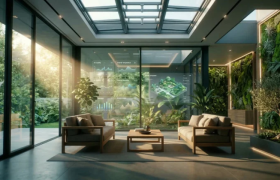
Living walls provide a high impact "Visual Connection with Nature" (Pattern 1) while utilizing minimal floor space—a critical advantage in dense urban real estate.
As the discipline matures, biophilic design is moving away from the "jungle" aesthetic of the early 2020s toward a more sophisticated, grounded, and scientifically rigorous approach.
Design forecasts for 2025 indicate a decisive shift toward darker, more enveloping color palettes. This trend, highlighted by Pantone's focus on "Mocha Mousse" and rich browns, aligns with the biophilic concept of Refuge.
The frontier of material science is shifting from "sustainable" (doing less harm) to "regenerative" (doing good).
The popular fusion of Japanese rustic minimalism (wabi-sabi) and Scandinavian functionality (hygge) is evolving. "Japandi 2.0" softens the clean lines of its predecessor.
Paradoxically, technology is enabling deeper connections to nature.
Biophilic design is not a cost; it is an investment with measurable returns across various sectors.
While the benefits are clear, barriers to implementation exist. Addressing them requires strategic planning.
Biophilic design faces four primary challenges: cost, maintenance, limited space, and inauthentic implementation.
Costs can be managed through phased investment, beginning with high-impact elements such as circadian lighting and potted plants, while leveraging green building certifications like WELL or LEED for long-term value. Maintenance issues—such as plant failure or material degradation—can be mitigated through automation, smart irrigation, and selecting highly resilient plant species, or by outsourcing to professional services.
Space limitations in dense urban environments can be addressed through vertical solutions like hanging planters and green walls, as well as multifunctional elements that serve both aesthetic and acoustic purposes. Finally, authenticity is essential; real, natural materials and locally relevant ecological references provide genuine psychological benefits, unlike artificial substitutes.
In short, successful biophilic design requires strategic planning, resilient systems, and material authenticity—not merely decorative greenery.
As we navigate the mid-21st century, the definition of architectural excellence is shifting. It is no longer sufficient for a building to be merely structurally sound or aesthetically striking; it must also be biologically nourishing. The integration of biophilic design—grounded in the evolutionary insights of E.O. Wilson and the rigorous data of modern neuroscience—offers a path forward.
The evidence is overwhelming: spaces that ignore our biological need for nature are stressful, inefficient, and detrimental to health. Conversely, spaces that embrace the "14 Patterns"—that offer prospect and refuge, dynamic light, and the complex textures of life—unlock human potential. Whether through the installation of a modular green wall in a high-rise office, the tuning of LED lights to the solar cycle in a home, or the simple placement of a Snake Plant in a dimly lit corner, every biophilic intervention is a step toward reconciling our primal biology with our modern reality. In 2026 and beyond, the most successful buildings will be those that function less like machines and more like habitats, fostering a symbiotic relationship between the built environment and the living world.