


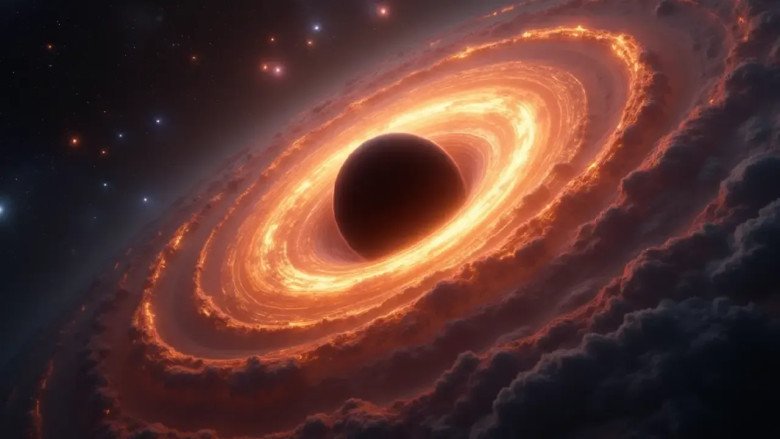
Imagine standing at the edge of a waterfall. But this isn't water cascading down; it is space itself, falling, collapsing, and dragging time along with it. If you slip, there is no hitting the bottom. There is only a stretching, an endless fall into a point where "where" and "when" lose their meaning. For decades, scientists looked at the math of the cosmos and hoped that what they saw wasn't true. They hoped that nature wouldn't allow such monstrosities to exist. But nature, as we have learned, is rarely subtle.
We are talking about black holes and the secrets of the universe that remain locked tightly within their gravitational grip. These aren't just dark spots in the sky. They are the engines of destruction and creation, objects so dense that they puncture the very sheet of reality. For the longest time, they were just ghosts in Einstein's equations. Now, we know they are real. They are out there, right now, swallowing light and keeping the history of the universe hidden in their bellies. To understand them is to try and read the mind of God.
A Flaw in the Fabric of Reality
To truly grasp what a black hole is, you have to forget the idea of gravity as a "force" that pulls you down. Instead, picture a trampoline. If you put a bowling ball in the center, the fabric curves. If you roll a marble nearby, it circles the curve. Now, imagine that bowling ball is so heavy and so small that it doesn't just curve the fabric—it rips it. Or, more accurately, it creates a funnel so deep that the sides become vertical.
That is the Event Horizon. It is the point of no return. Once you cross that invisible line, you would need to travel faster than the speed of light to escape. Since the laws of physics strictly forbid anything from traveling faster than light, nothing escapes. Not a radio signal, not a photon, not a scream.
Inside, we encounter the "Singularity." This is where things get uncomfortable for physicists. All the mass of the object is crushed into a point of infinite density and zero volume. It makes no sense. When infinite density enters the equation, the math breaks. It suggests that our understanding of black holes and the secrets of the universe is fundamentally incomplete. Is it a portal? Is it the end of time? Or is it a state of matter we simply don't have the language to describe yet?
The Violent Death of Stars
How does the universe create such a monster? It begins with a tragedy: the death of a massive star. A star is a battlefield. On one side, you have Gravity, always trying to crush the star inward. On the other side, you have Fusion, the nuclear explosions in the core pushing outward. For millions of years, it is a stalemate. The star shines, life is good, and the balance holds.
But eventually, the fuel runs out. The fusion stops. The pressure pushing out disappears. Gravity, which has been waiting patiently for eons, finally wins.
-
- The Instant Collapse: In a fraction of a second, the core of the star (iron) collapses. We are talking about an object the size of Earth shrinking to the size of Manhattan in less time than it takes you to blink.
- The Supernova: The outer layers of the star rush inward, slam into the super-dense core, and bounce off. This results in an explosion so bright it can outshine an entire galaxy. It scatters the building blocks of life—carbon, oxygen, gold—into space.
- The Remnant: If what is left of the core is heavy enough (more than three times our Sun), nothing can stop the collapse. It doesn't stop at a neutron star. It keeps going. It shrinks until it vanishes from sight, leaving only its ghost—gravity—behind. A black hole is born.
The Giants Lurking in the Dark
The scary part isn't the dead stars scattered around our galaxy. The scary part is what sits in the middle of it. Every large galaxy, including our own Milky Way, revolves around a "Supermassive Black Hole." These aren't formed from a single star. These are titans, weighing millions or billions of times the mass of our sun. We call the one in our backyard Sagittarius A*. It is relatively quiet, a sleeping giant.
But further out in the deep cosmos, these monsters are awake. They are feeding. As they swallow gas, dust, and entire star systems, they heat up. They glow brighter than a trillion suns. These are "Quasars." It is a beautiful irony: the darkest objects in the universe are capable of creating the brightest lights in existence. But how did they get so big? This remains one of the top unanswered questions when we discuss black holes and the secrets of the universe. Did they merge with others? Did they form from colossal clouds of gas at the dawn of time? We are essentially like ants trying to understand how a skyscraper was built.
The Whispers of Stephen Hawking
If black holes only eat, the universe would eventually become a very dark, very empty place. But the late genius Stephen Hawking changed everything. He applied Quantum Mechanics—the physics of the very small—to the event horizon. He realized something shocking: black holes aren't completely black. They leak.
This "leak" is now called Hawking Radiation. Over incredibly vast timescales, a black hole radiates energy, loses mass, and shrinks. Eventually, after trillions upon trillions of years, it will evaporate completely, perhaps vanishing in a final puff of gamma rays. But this leads to a crisis.
-
- The Information Paradox: Physics says information cannot be destroyed. If you burn a book, the ash and smoke still contain the information of the book, theoretically recoverable.
- The Lost Data: If a black hole disappears completely, what happens to the things it ate? Does the "information" of that star or spaceship vanish from the universe?
- The Holographic Universe: To solve this, some scientists suggest that the information is plastered on the surface of the Event Horizon, like a 2D sticker. This leads to the wild theory that our entire 3D universe might actually be a hologram projected from a 2D surface.
This suggests that black holes aren't just trash cans; they are the hard drives of the cosmos, and we just haven't learned how to plug in the USB yet.
Why We Stare at the Void
Why spend billions of dollars taking photos of a black hole? Why does it matter? It matters because they are the ultimate laboratory. You cannot build a black hole in a lab on Earth (and we really shouldn't try). To test the limits of Einstein's theories, to find out where gravity comes from, and to perhaps find a way to cheat time, we have to look at them.
Time behaves differently near them. If you stood near the Event Horizon for an hour, years might pass back on Earth. They are essentially time machines that travel only forward. Unlocking black holes and the secrets of the universe is our best shot at understanding the origin of the Big Bang itself, for the Big Bang was essentially a singularity in reverse—explosion instead of implosion.
Conclusion: The Eternal Question
We live on a small rock orbiting an average star, drifting through a quiet arm of a vast galaxy. It is comforting to think the universe is stable. But out there in the dark, the leviathans are lurking. They are tearing stars apart and bending the light of ancient galaxies.
The study of black holes is a humbling reminder of our size, but a proud testament to our curiosity. We are the only species that looks at the darkness and dares to ask "Why?". As technology improves and our telescopes peer deeper into the shadow of the Event Horizon, we may find that the black hole is not an end, but a beginning—a doorway to a new physics, or perhaps, a new reality entirely. Until then, they keep their secrets well, silently anchoring the spinning dance of the stars.
Black Holes Explained | The Most Mysterious Objects in the Universe
You may also like
-

How to Optimize Your Website for Google SGE & Win AI Search
-
The Engineering Secrets Behind Ancient Megastructures
-
OpenAI Sora vs Midjourney v6: Best AI Tools for Marketers
-
Midjourney v6: The Complete Guide to Advanced Prompts & Photorealism
-
The Rise and Fall of OpenAI Sora: What Happened to the Video AI Giant?
-
Apple Watch Series 11 Review: Is It Worth the Upgrade?




















Comments
0 comment