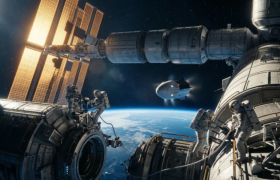
Commercial Space Stations: What Happens After the ISS Retires?
Discover what happens after the ISS retires. Explore how commercial space stations and private orbital habitats are driving the new low Earth orbit economy.




 by Simo Naboussi
 Imagine possessing a time machine that could transport you back four billion years to witness the chaotic, dramatic birth of our own Solar System. While such a device remains firmly in the realm of science fiction, the cosmos has provided us with a magnificent, natural substitute: the Beta Pictoris star system.
Located a remarkably close 63 light-years away, Beta Pictoris is not just another star; it is a celestial laboratory, a vibrant construction site caught in the middle of forming its own family of worlds.Crucially, at a mere 12 to 26 million years old, this system is an energetic, restless teenager compared to our middle-aged Sun, offering astronomers a high-definition, live-action view of planetary evolution.It is precisely this combination of proximity, youth, and extraordinary features—including the first debris disk ever spatially imaged and two massive, directly-observed exoplanets—that makes the study of Beta Pictoris absolutely indispensable to understanding our own origins. For anyone fascinated by the dynamics of solar systems, the story of Beta Pictoris is the definitive, action-packed prequel.
The core mystery surrounding Beta Pictoris lies in its dynamic, messy inner workings. We are not observing a static, settled system. Instead, we see powerful gravitational tugs, relentless cometary bombardment, and planetary migration all happening at once.
The word Beta Pictoris has become synonymous with a complex, evolving stage of planetary system development that bridges the gap between the initial, gas-rich protoplanetary disk and the mature, stable systems like ours. By dissecting the light, dust, and gas from this one system, scientists are unlocking universal laws of celestial mechanics.
At the center of this cosmic drama is the star itself, designated Beta Pictoris. This is not a Sun-like star; it's an A-type main-sequence star, a celestial powerhouse that is significantly hotter, brighter, and more massive than the star that illuminates Earth. Specifically, Beta Pictoris boasts nearly double the mass of the Sun (about 1.75 solar masses) and shines with a brilliance that is almost nine times greater.
This massive energy output is critical, as its intense radiation pressure plays a pivotal role in sweeping lighter dust particles out of the system, sculpting the shape of the massive debris disk that surrounds it. This star, therefore, is not merely a light source; it is an active, gravitational and radiative engine constantly shaping its planetary environment.
The youth of Beta Pictoris is its most defining trait. At around 20 million years old, it’s old enough for the initial, opaque protoplanetary disk to have dissipated, but young enough for the planet formation process to still be in its highly dynamic, sometimes violent, secondary phase.
This puts Beta Pictoris squarely in the stellar "adolescence" category. Moreover, the star lends its name to the Beta Pictoris moving group, an association of hundreds of young stars that were all born together from the same giant molecular cloud and now travel through space as a loosely bound family.
This association provides astronomers with a reliable, common age estimate for the entire system, a crucial anchor for validating evolutionary models. Observing this bright, young star allows us to look back in time and understand the energetic environment that existed when rocky planets like ours were just beginning to coalesce from smaller planetesimals.
The discovery of the debris disk around Beta Pictoris in the early 1980s was a monumental achievement, marking the first time scientists had spatially resolved such a structure around another star. This disk is the system's most celebrated feature, stretching to nearly 2,000 Astronomical Units (AU), dwarfing our own Solar System's Kuiper Belt.
It is oriented almost perfectly edge-on from our perspective, providing an unparalleled, high-contrast silhouette that is a goldmine for detailed structural analysis. This isn’t a leftover gas disk; it is a dynamic graveyard of planetesimals, constantly replenished by the violent, high-speed collisions of comets and asteroids—the cosmic wreckage of system formation.
The disk is far from a smooth, uniform ring. Detailed imaging has revealed striking complexities that point directly to the presence of massive, hidden forces within. The inner region of the disk exhibits a distinct warp, a bending that can only be explained by the powerful, tilted gravitational pull of a massive body, which we now know to be the inner planet, Beta Pictoris c.
Furthermore, the outer disk displays significant brightness asymmetries, with one side appearing much more extended and luminous than the other, suggesting either the influence of an external star or, more likely, the gravitational scattering effects of the system’s giant planets.
Analyzing the thermal emission from the disk reveals that the dust is rich in crystalline silicates, a composition remarkably similar to the comets found in our own Solar System—a profound clue that the materials for building planets are universally the same.
The gravitational complexities observed in the debris disk were a clear signal that something massive was stirring the pot. That something turned out to be at least two giant worlds, Beta Pictoris b and Beta Pictoris c, both revolutionary discoveries in exoplanetary science. These planets are not just orbiting the star; they are actively dictating the system's architecture, sculpting the disk, and driving the flow of smaller bodies.
The first planet, Beta Pictoris b (beta Pic b), is a phenomenal case study. It's a gas giant estimated to be about 9 to 13 times the mass of Jupiter, orbiting at a wide distance of roughly 9 to 10 AU—about the distance of Saturn from our Sun.
Its direct imaging was a triumph, but what makes it truly exceptional is its rotation: beta Pic b is a cosmic sprinter, completing a full day in a jaw-dropping 8 hours, making it one of the fastest spinning giant planets ever measured.
This extreme rotation rate offers invaluable data on the atmospheric dynamics, cloud formation, and internal structure of rapidly accreting young worlds.
The discovery of the second planet, Beta Pictoris c (beta Pic c), was achieved not by direct imaging but primarily through precise radial velocity measurements and later confirmed by interferometry, revealing a planet much closer to the star, orbiting at only 2.7 AU.
Despite its slightly lower mass (estimated at 8 to 10 Jupiter masses), beta Pic c is the gravitational engine of the inner system. Its close proximity means it is the chief architect responsible for two major phenomena: the warp observed in the inner disk, and, most dramatically, the persistent mechanism that launches the thousands of comets we see plunging toward the star.
The most unique and mesmerizing feature of the Beta Pictoris system is the constant stream of objects dubbed Falling Evaporating Bodies (FEBs). These are essentially comets or small planetesimals that have been gravitationally catapulted from the system's outer reservoir and put on a collision course, or at least a star-grazing course, with Beta Pictoris. We don't see the comets themselves, but we detect their ghostly signature.
As these bodies fly extremely close to the star (within a few million miles), the star's ferocious heat vaporizes their icy material. This sublimation releases vast clouds of gas and dust, which briefly absorb some of the star's light. Astronomers detect this event as rapidly shifting, variable absorption lines in the star's spectrum, which appear in constant flux—a clear sign that hundreds of these objects are making a death plunge every year. This phenomenon provides a direct, measurable link between the massive planets and the small, icy bodies of the disk.
The FEB phenomenon, a key to understanding planet-driven scattering, involves several factors:
Even with decades of intense scrutiny, Beta Pictoris continues to hold secrets. The system remains a prime target for the James Webb Space Telescope (JWST) and upcoming extremely large telescopes, which will push the boundaries of resolution and sensitivity to reveal even more intricate details. The ability to peer into the inner regions of the disk, where rocky, terrestrial planets might be forming, is the next great frontier in Beta Pictoris research.
The structures and asymmetries in the disk strongly suggest the presence of more worlds, perhaps smaller, Neptune-sized or even Earth-sized planets that have yet to be confirmed. These hidden architects could be responsible for the fine-tuning of the debris disk's outer edges and the exact distribution of dust and gas.
Additionally, determining the precise orbital properties of beta Pic b and c—are they in a stable resonance, or are they migrating?—is crucial for predicting the long-term stability and evolution of the entire Beta Pictoris system. The dynamic environment guarantees that this star will be a source of cutting-edge discoveries for generations to come.
Future observations will aim to clarify specific points:
The word Beta Pictoris is more than an astronomical designation; it represents a profound scientific achievement and a deep connection to our own cosmic history. This single, young star system, just a short hop away in galactic terms, provides the definitive blueprint for how planets form.
The violent, beautiful processes we witness—the gravitational dominance of Beta Pictoris b and c, the sculpting of the vast debris disk, and the dramatic fate of the Falling Evaporating Bodies—are the very events that shaped Earth and our entire Solar System billions of years ago.
In essence, Beta Pictoris is a time capsule, a live-action documentary playing out at the edge of our telescopes. It constantly challenges our theories, demands more from our technology, and ultimately provides the most convincing evidence yet that the formation of planets is a universal, robust process.
To study Beta Pictoris is to better understand our own home, solidifying its place as one of the most critical and enduring targets in the grand exploration of the cosmos.
 Mar 15, 2026
 Discover what happens after the ISS retires. Explore how commercial space stations and private orbital habitats are driving the new low Earth orbit economy.
 Feb 01, 2026
 Explore the technical bottlenecks stalling NASA’s Artemis program and how China’s methodical lunar strategy could allow Beijing to claim the strategic South Pole first.
 Dec 26, 2025
 Is space travel the ultimate destiny of humankind? Explore the evolution of cosmic exploration, the grit of Mars missions.