


 by Simo Naboussi
 We often think of math as a cold, modern invention—a world of calculators, complex software, and chalkboard scribbles that haunt our school memories. But if we peel back the layers of history, we find that Ancient Mathematics was never just about numbers; it was a visceral human response to the chaos of the world.
It was the desperate need of a farmer to know when the river would rise, the ambition of a king to build a monument that touched the heavens, and the curiosity of a priest watching the rhythmic dance of the planets. This wasn't just arithmetic; it was the birth of logic itself.
When we study Ancient Mathematics, we aren't just looking at old formulas; we are looking at the very DNA of human intelligence, a bridge built by our ancestors to cross from the unknown into the light of understanding.
Long before the first city-state was ever dreamed of, the human mind was already grappling with the concept of "more" and "less." We often underestimate our prehistoric cousins, but the roots of Ancient Mathematics are buried in the African caves and the frozen tundras of the Ice Age.
Imagine a hunter-gatherer carving notches into a wolf’s bone—the famous Ishango bone. This wasn't just a doodle. It was a rhythmic recording, perhaps of the moon's phases or a successful hunt. This act of "tallying" represents the first time a human brain separated a quantity from the object itself. It was the moment we realized that three bison and three days were both connected by the abstract concept of 'three.'
As these nomadic groups began to settle, the stakes for Ancient Mathematics grew exponentially. If you are planting seeds, you need to count them. If you are storing grain for the winter, you need to know if you have enough to survive until spring. This transition from "counting on fingers" to "managing a surplus" forced the brain to develop more sophisticated tools.
We see the emergence of base systems—ways to group numbers to make them manageable. Some cultures looked at their ten fingers (base 10), while others looked at the joints of their fingers and their toes. This wasn't a textbook exercise; it was a survival strategy that laid the groundwork for everything that followed.
In the dust of modern-day Iraq, the Babylonians were performing intellectual feats that still dictate how we live our lives every single day. While we mostly use a base-10 system today, the architects of Mesopotamia leaned into a base-60 (sexagesimal) system. Why 60? It sounds complicated to us, but for them, it was the ultimate practical choice.
If you count the three phalanges (knuckles) on each of your four fingers using your thumb as a pointer, you get 12. Do that five times (one for each finger on the other hand), and you get 60. This tactile, human-centered approach to Ancient Mathematics is the reason your minute has 60 seconds and your hour has 60 minutes.
But they didn't stop at time. The Babylonians were obsessed with the stars, and their mathematical models were so precise they could predict eclipses with startling accuracy.
Their clay tablets, etched with cuneiform, show us that they weren't just adding and subtracting. They were exploring the properties of right-angled triangles and calculating the areas of complex shapes.
They created the first "spreadsheets" on clay, keeping track of massive amounts of trade and taxes. In many ways, the Babylonian mathematician was the world’s first data scientist, turning the movement of the heavens and the flow of the marketplace into a predictable, logical system.
To understand Ancient Mathematics in Egypt, you have to understand the Nile. Every year, the river would flood, bringing life to the desert but also washing away every boundary marker between farms. When the water receded, the pharaoh’s tax collectors and surveyors had to step in. These men were known as "rope-stretchers." They used knotted ropes to create perfect right angles, using the 3-4-5 ratio. This was geometry in its most literal sense—"earth measuring." For the Egyptians, math was the tool used to restore order to the chaos of nature.
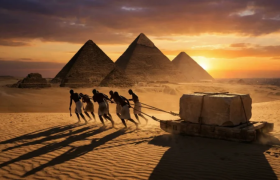
This practical mastery reached its zenith in the construction of the Great Pyramids. We often look at these structures as mysteries of "aliens" or "lost technology," but the truth is far more impressive: it was pure Ancient Mathematics.
The precision of the casing stones, the alignment to true north, and the consistent slope (the seked) all required a deep understanding of proportions and unit fractions. They didn't have decimal points, which made their calculations incredibly labor-intensive, yet they managed to approximate the value of Pi and calculate the volumes of truncated pyramids. They proved that with enough patience and a solid grasp of ratios, humanity could build mountains.
Something shifted when Ancient Mathematics reached the shores of Greece. The Greeks were not satisfied with just knowing *how* to measure a field or build a wall. They wanted to know the "Eternal Truth." For thinkers like Pythagoras, numbers weren't just symbols for things; they were the things themselves. There is a story that the Pythagoreans were so devoted to the perfection of numbers that when they discovered "irrational numbers"—numbers that go on forever without a pattern—they were horrified, seeing it as a flaw in the fabric of the universe.
This era gave us the "Proof." It wasn't enough to show that a formula worked; you had to prove it would work every single time, for all eternity. Euclid’s *Elements* became the most successful textbook in history because it built a world from the ground up, starting with a simple dot and a line and ending with the most complex 3D shapes. Archimedes, perhaps the greatest mind of antiquity, used these principles to design war machines and calculate the area of a circle by imagining it filled with an infinite number of tiny triangles. The Greeks turned math into a high art, a form of poetry written in the language of logic that challenged the human mind to think beyond the physical world.
If you look at Roman numerals, you quickly realize how difficult it is to do even simple multiplication. Imagine trying to do calculus with letters! The world was stuck in a numerical bottleneck until Ancient Mathematics in India made a discovery that was so simple, yet so profound, it changed the course of history: the number zero. Before this, "zero" was just an empty space, a placeholder. But Indian mathematicians like Brahmagupta and Aryabhata treated zero as a number with its own personality and rules.
The brilliance of the Indian system included several key shifts:
When this "Hindu-Arabic" system finally travelled through the Middle East and into Europe, it acted like a key in a lock. It unlocked the potential for the Renaissance, the Scientific Revolution, and eventually, the digital age. We owe our modern world to those ancient Indian scholars who realized that "nothing" (zero) was actually "everything."
In the East, Ancient Mathematics developed with a flavor of intense pragmatism and algorithmic efficiency. The Chinese were not interested in the mystical cults of the Greeks; they were interested in results. In the "Nine Chapters on the Mathematical Art," we see a civilization solving complex problems of engineering, taxation, and logistics. They were using negative numbers (red and black counting rods) long before the West, and they developed methods for solving systems of equations that wouldn't be seen in Europe for another thousand years.
The Chinese approach was remarkably modern because it was procedural. They developed "algorithms"—step-by-step instructions to reach a solution. This mindset led to the perfection of the abacus, a tool that allowed even a merchant in a busy market to perform calculations faster than someone with a pen and paper. Their mathematicians, like Zu Chongzhi, were so precise that they calculated Pi to a level of accuracy that wasn't surpassed for a millennium. This tradition shows us that Ancient Mathematics was never a single story, but a global conversation where different cultures solved the same human problems in beautifully different ways.
When we look back at the vast landscape of Ancient Mathematics, we see more than just a timeline of discoveries. We see a mirror of the human spirit. We see the Babylonian priest, the Egyptian architect, the Greek philosopher, the Indian sage, and the Chinese bureaucrat all trying to find a sense of order in a world that often felt chaotic and unpredictable. They didn't have the luxury of modern technology, yet they mapped the stars, built the wonders of the world, and gave us the language we use to communicate with computers today.
In conclusion, Ancient Mathematics is the silent pulse of our civilization. It is the invisible scaffolding that holds up our bridges, the logic that powers our phones, and the rhythm that governs our time. By rediscovering these ancient roots, we don't just learn about the past; we learn about ourselves. We learn that humans have always been "pattern-seekers," and that our ability to turn numbers into meaning is perhaps our greatest superpower. As you move through your day, remember that every time you check the time or count your change, you are participating in a tradition that spans thousands of years. Ancient Mathematics isn't dead; it is alive in every corner of our modern existence, whispering the secrets of the universe to anyone willing to listen.