AI vs Human Creativity: The Rise of the Human Premium
Explore the defining shift in AI vs Human Creativity. Discover why authentic human insight is the ultimate SEO advantage and how to thrive.

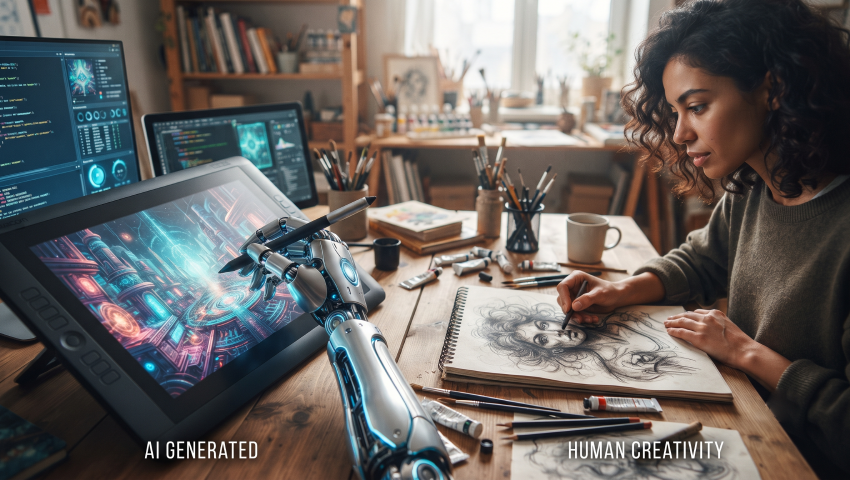
The landscape of professional content creation, marketing strategy, and artistic expression has undergone a tectonic shift, culminating in the complex, multifaceted reality of 2026. We stand at a pivotal juncture in human history, a moment that future historians might label the “Cognitive Age,” where the monopoly on intelligence—and specifically, the ability to generate novel ideas—has been decisively broken. For millennia, creativity was the defining characteristic of the human species, the divine spark that separated us from the beasts of the field and the tools in our hands. Today, that spark is being emulated, replicated, and in some metrics, surpassed by silicon-based neural networks that operate on a scale of data consumption incomprehensible to the biological mind.
The initial, often hysterical, debates that characterized the early 2020s—framing the relationship between artificial intelligence and human ingenuity as a zero-sum battle for dominance—have largely evaporated. The “robots will replace us” narrative has proven to be simplistic and, largely, incorrect. Instead, a more nuanced, sophisticated, and occasionally unsettling dynamic has emerged. We are no longer asking if AI can create; the evidence of our eyes and ears confirms that it can. Algorithms now generate symphonies that move us, essays that persuade us, and visual art that arrests us. The question has shifted from capability to ontology: what constitutes creativity in an era where machines can simulate the artifacts of genius in seconds? And, perhaps more critically for the global economy, why does human provenance command an increasingly high premium in a marketplace flooded with synthetic output?
The pervasive integration of Generative AI (GenAI) into the fabric of digital life has forced a radical re-evaluation of the very nature of human intelligence. As tools like ChatGPT, Claude, and Midjourney have evolved from novelties into infrastructural necessities, functioning as the electricity of the creative economy, they have exposed the mechanical underpinnings of tasks we once considered the exclusive province of the human soul. We have learned that syntax, structure, and style are solvable math problems. Yet, paradoxically, as machines have mastered the art of form, the specific deficiencies of algorithmic “creativity”—its lack of intentionality, emotional depth, and lived experience—have become the defining metrics of value. The market has shifted from celebrating the sheer speed of automation to craving the “Human Premium,” a phenomenon where the discernible touch of biological consciousness becomes the ultimate luxury good in a world of infinite digital abundance.
This report offers an exhaustive, expert-level analysis of the state of AI versus Human Creativity as it stands in the mid-2020s. It explores the ontological distinctions between biological imagination and probabilistic generation, the neurological divergence between human brain networks and artificial neural networks, and the practical implications for industries ranging from SEO and content marketing to fine art and organizational management. By synthesizing data from neuroscience, computer science, behavioral economics, and cultural criticism, this document aims to provide a definitive roadmap for navigating the “Centaur” age—where the future belongs not to the machine alone, nor the human alone, but to the seamless, if occasionally friction-laden, collaboration between the two.
Part I: The Ontological Divide – Defining Creativity in the Age of Algorithms
To navigate the competitive and collaborative dynamics between human and machine, we must first establish a rigorous definition of creativity itself. The popular conception of creativity as a mysterious “spark” or a divine intervention is insufficient for analyzing the capabilities of Large Language Models (LLMs) and diffusion models. Instead, we must turn to cognitive frameworks that dissect the creative process into constituent mechanisms, allowing us to see exactly where the machine creates a facsimile of the process and where it engages in the process itself.
1. Margaret Boden’s Three Types of Creativity
The most robust framework for evaluating AI performance remains the tripartite model proposed by cognitive scientist Margaret Boden. Her classification system allows us to precisely map where AI excels and where it fundamentally fails, moving the conversation beyond vague assertions of “soul” into measurable cognitive territories.
✅ Combinational Creativity: The Machine’s Playground
Combinational creativity involves making unfamiliar connections between familiar ideas. It is the art of the remix, the collage, and the synthesis. This is the domain where Generative AI currently reigns supreme, arguably surpassing human capability in terms of speed and volume. LLMs, by their very architecture, are massive association engines. They operate on the principle of probabilistic connection, analyzing billions of parameters to find statistical relationships between concepts that a human mind might never pair.
Consider the cognitive load required for a human to combine two disparate genres—say, a recipe for beef bourguignon written in the style of a cyberpunk noir novel. A human writer must mentally retrieve the vocabulary of French cooking, the tropes of the cyberpunk genre, and the syntactic structure of noir fiction, and then laboriously braid them together. An AI, however, does not “retrieve” these as separate files; they exist within its multidimensional vector space as probabilistically linked tokens. The request is merely a vector calculation. It can generate thousands of combinational variations in the time it takes a human to conceptualize one. This “combinational” dominance explains why AI is so effective at brainstorming, “remixing” content, and generating initial drafts that merge differing tones or topics. It is the ultimate “Yes, And” machine, unburdened by the cognitive friction of context switching.
✅ Exploratory Creativity: Navigating the Rules
Exploratory creativity involves operating within a structured conceptual space to discover new possibilities that exist within the rules of that space. This is evident in fields like mathematics, music composition, or rigid poetic forms. Because AI is fundamentally rule-based—governed by the weights and biases of its neural network and the parameters of its training data—it is exceptionally adept at exploratory creativity.
The most famous example of this remains DeepMind’s AlphaGo and its legendary “Move 37” against Lee Sedol. Commentators at the time gasped, calling the move “creative” and “alien.” However, in Boden’s framework, this was a supreme act of exploratory creativity. The move existed within the finite rules of Go; it was not a violation of the game, but an exploration of the game’s “map” into territories that human tradition, with its reliance on heuristics and received wisdom, had ignored. The AI explored the conceptual space more thoroughly than any human could, finding a path that was valid but unprecedented. Similarly, in marketing, AI can explore the “rules” of a brand voice or a platform algorithm to optimize content performance, finding the most efficient path to a metric goal that a human strategist might miss due to cognitive bias or fatigue.
✅ Transformational Creativity: The Human Fortress
This is the “Holy Grail” of human cognition and the area where AI faces its hardest ceiling. Transformational creativity involves altering the conceptual space itself—breaking the rules to create a new paradigm. It is Picasso inventing Cubism, not just painting another portrait. It is Einstein reimagining physics, not just solving an existing equation. It is the moment where the rules of the genre are discarded in favor of a new syntax of meaning.
Current research suggests that while AI can mimic the artifacts of transformational creativity (by hallucinating or error-prone generation that accidentally breaks rules), it lacks the intentionality to do so meaningfully. AI models are designed to minimize loss functions—to reduce error and conform to patterns. Transformational creativity requires a deliberate rejection of the pattern. A machine cannot decide that the rules of the game are boring and invent a new game; it can only play the existing game with superhuman efficiency. It lacks the dissatisfaction with the status quo that drives human revolution. This distinction remains the primary fortress of human advantage. The machine can write a perfect sonnet, but it cannot decide that the sonnet is a dead form and invent free verse.
2. The Role of Intentionality and “The Why”
The deepest chasm between human and AI creativity lies in the concept of intentionality, or teleology. Human creativity is driven by a purpose, an emotion, or a desire to communicate a specific internal state to an external audience. A human artist paints a scene of grief because they have experienced loss and wish to process it or share it. The work is a bridge between two conscious minds.
In contrast, AI acts without internal motivation. It generates content because it was prompted to do so. As noted in recent critiques of AI art, the machine is a “master of the ‘what’, but it lacks the ‘why'”. It produces outputs that behave like creative products—they surprise, they combine elements, they follow aesthetic rules—but they are severed from the lived experience that gives art its resonance. This is why AI-generated novels often meander; there is no “controlling idea” or burning desire to convey a truth, only a probabilistic sequence of events that usually happen in novels.
This absence of “soul” or “lived truth” is not merely a philosophical objection; it is a tangible quality that audiences can detect. Research indicates that while AI can mimic the texture of emotion (using sad words or minor keys), it struggles to replicate the structure of emotional narrative, often resulting in works that feel “hollow,” “flat,” or “uncanny”. The machine has never had its heart broken, never felt the warmth of the sun, and never feared death; consequently, its simulations of these experiences are essentially statistical approximations of human descriptions of these feelings, rather than the expression of the feelings themselves.
Part II: Cognitive Architecture vs. Computational Probability
To understand why AI writes and creates the way it does—and why it differs from humans—we must look at the hardware. The comparison between the human brain’s biological neural networks and the artificial neural networks (ANNs) of Silicon Valley reveals fundamental differences in how “ideas” are generated, processed, and refined.
1. The Neuroscience of Human Insight: DMN vs. ECN
Human creativity is not a single process but a dynamic interplay between distinct, often opposing, brain networks. Neuroscience has identified two primary systems responsible for creative thought: the Default Mode Network (DMN) and the Executive Control Network (ECN). Understanding this biology is crucial to understanding why human ideas often feel “organic” and fluid compared to the rigid structure of AI.
The Default Mode Network (DMN) is the brain’s “idle” state. It is active during rest, daydreaming, and spontaneous thought. It is the seat of the imagination, where the mind wanders through memories, hypothetical scenarios, and self-reflection. It is largely responsible for the generation of novel, unrestricted, and associative ideas—the “shower thoughts” or the sudden strikes of inspiration that seem to come from nowhere.
The Executive Control Network (ECN), conversely, is the brain’s manager. It is active during focused tasks, problem-solving, and evaluation. It filters, evaluates, and refines ideas for utility and logic. In most cognitive states, these two networks are anticorrelated; when one is on, the other is off. We are either daydreaming (DMN) or focusing (ECN).
However, research demonstrates that highly creative individuals have a unique ability to co-activate these networks. They can engage in spontaneous mind-wandering (DMN) while simultaneously maintaining the cognitive control (ECN) to evaluate those wandering thoughts for value. This “synchrony” allows for the creative flow state—the ability to generate wild ideas and immediately assess them for relevance and structure. The AI, lacking this biological dualism, simulates the result of this process (the final text) without undergoing the process of chaotic generation and disciplined filtering.
2. The Embodied Mind: Why Biology Matters
Furthermore, human cognition is “embodied.” Our thoughts are not abstract data processing; they are inextricably linked to our sensory inputs, our hormonal states, and our physical environment. A human idea is often triggered by a smell, a memory of a physical sensation, or a somatic marker (a “gut feeling”). The human brain creates meaning through associative memory that is deeply contextual and emotional.
When a human writer describes “the chill of a winter morning,” they are accessing a stored physical memory of cold, the tightening of skin, the visible breath. They are translating a physical sensation into language. When an AI writes the same phrase, it is accessing a statistical cluster of words where “chill,” “winter,” and “morning” frequently appear together. It has no access to the physical reality. This is why AI writing often fails at sensory details that are not clichés; it knows the “average” description of winter, but not the specific, idiosyncratic details that make a description feel real.
3. The Architecture of the Transformer: Probability over Personality
Artificial Neural Networks, specifically the Transformer architecture underlying models like GPT-4, operate on a fundamentally different principle: Next-Token Prediction.
An LLM does not “know” anything in the human sense. It does not have memories, trauma, or joy. It possesses a massive multidimensional vector space where words (tokens) are positioned based on their statistical relationship to one another. When an AI “writes,” it is calculating the probability of the next word in a sequence based on the context of the preceding words and its training data.
This mechanism explains the specific strengths and weaknesses of AI writing:
- The Hallucination Feature: Because the AI is probabilistic, not factual, it will prioritize the most likely sounding continuation over the truth. If the pattern suggests a citation should exist, the AI will invent one that looks plausible because, statistically, a citation often follows a claim in academic writing.
- The “Average” Bias: Because AI is trained on the internet, its output tends to regress toward the mean. It produces the “average” of all human writing—grammatically perfect, structurally sound, but often banal and cliché-ridden. It struggles to produce the “outlier” thoughts that characterize genius because outliers are, by definition, statistically improbable.
- Lack of Subtext: The Transformer model utilizes “Attention Mechanisms” to track relationships between words, but it cannot track relationships between unsaid things. It struggles with subtext, irony, and sarcasm because these rely on the divergence between what is said and what is meant—a gap that purely statistical analysis often fails to bridge. It reads the text literally because it has no “Theory of Mind” to understand the speaker’s hidden intent.
4. The Efficiency vs. Energy Paradox
A stark comparison exists in the energy efficiency of these systems. The human brain operates on approximately 20 watts of power—roughly that of a dim lightbulb. In contrast, training and running large AI models requires megawatts of energy and massive GPU clusters. This highlights the extraordinary efficiency of biological evolution; the human brain achieves transformational creativity with a fraction of the energy required for an AI to achieve combinational creativity. This biological efficiency is rooted in our ability to generalize from very few examples (few-shot learning), whereas ANNs require massive datasets to learn simple patterns.
Part III: The Uncanny Valley of Content and the “Slop” Crisis
As AI tools have proliferated, a new aesthetic phenomenon has emerged: the “Uncanny Valley” of text and image. Originally coined by roboticist Masahiro Mori to describe the revulsion humans feel toward robots that look almost but not quite human, this concept now applies to AI-generated content. We have entered an era where text can feel “zombie-like”—technically alive, but devoid of the vital spark.
1. The Anatomy of “AI Slop”
By 2025, the internet became inundated with what critics and analysts termed “AI slop”—low-quality, high-volume content generated to game algorithms rather than serve humans. This content is characterized by a veneer of polish but a core of emptiness. It is the “Polonius problem”—stating the banal with high confidence and elaborated vocabulary. It is the blog post that uses 500 words to say nothing, the image that looks perfect until you count the fingers, the email that sounds polite but conveys no actual information.
Humans have developed a rapid, almost subconscious detection mechanism for this content. Just as we can spot the “dead eyes” of a CGI character, we can spot the “soulless” cadence of AI writing. It feels too smooth, too balanced, too neutral. It lacks the jagged edges of human thought—the slight digressions, the variations in sentence structure, the idiosyncratic vocabulary that marks a specific individual’s voice.
2. Linguistic Fingerprints: The “AI-isms”
The training processes of LLMs, particularly Reinforcement Learning from Human Feedback (RLHF), have inadvertently created a specific “dialect” of AI English. To make models safe, helpful, and harmless, they are fine-tuned to be neutral, comprehensive, and polite. This has resulted in the overuse of specific words and phrases that have become shibboleths for AI generation. These are the words that AI relies on to transition between ideas without committing to a strong opinion, or to sound “smart” without saying anything specific.
The Lexicon of AI Detection (2024-2026)
Between 2024 and 2026, AI-generated writing developed recognizable lexical patterns—subtle but statistically predictable word choices that increasingly function as detection signals. Many of these terms are not incorrect; they are simply overrepresented due to probabilistic language modeling favoring safe, neutral transitions and high-frequency academic phrasing.
Words like “delve” and “in conclusion” reflect structured essay conventions embedded heavily in training data. While grammatically sound, they often feel overly formal or mechanically inserted, triggering reader suspicion. Similarly, abstract metaphors such as “tapestry” and “landscape” are commonly used by AI to signal complexity without committing to concrete detail, which humans perceive as vague padding.
Corporate-leaning constructions like “testament to,” “foster,” and “underscore” provide safe rhetorical emphasis without assigning agency or specificity. These phrases read polished but emotionally distant, resembling press release boilerplate rather than lived analysis. High-probability hype terms such as “game-changer” further erode credibility, signaling marketing language instead of nuanced argumentation.
Even words like “realm”—technically correct—can feel archaic or unnecessarily grand in technical contexts, revealing a stylistic mismatch between tone and topic.
Importantly, none of these words inherently prove AI authorship. The signal emerges from clustering, frequency, and tonal uniformity rather than isolated usage. Human writing tends to vary rhythm, inject specificity, and occasionally break structural symmetry. AI detection increasingly depends not on vocabulary alone, but on patterns of predictability, abstraction density, and rhetorical safety.
In short, the lexicon of AI detection is less about forbidden words and more about statistical fingerprints.
The psychological rejection of these terms is not merely linguistic snobbery; it is a rejection of the lack of effort they represent. When a reader encounters “In the rapidly evolving digital landscape, it is crucial to delve into…” they instantly recognize that no human mind struggled to craft that sentence. It is a probabilistic output, and therefore, it carries less weight. It signals that the writer (or prompter) did not care enough to formulate a unique thought.
3. Gaze Patterns and Implicit Bias: The Science of Perception
Recent research from 2025 has quantified this bias, showing that it extends beyond conscious judgment into subconscious perception. A study analyzing gaze patterns found that while people physically looked at AI-generated art and human art in similar ways (fixation counts, duration, pupil dilation), their subjective evaluation was radically different.
When participants believed an artwork was human-made, they rated it significantly higher in emotional resonance, sincerity, and quality. They found it more “moving” and ascribed higher “communicative intent” to it. However, when told the same image was AI-generated, ratings for “sincerity” and “emotion” collapsed. Interestingly, the eye-tracking data showed that the effort to process the image was the same—the brain still found the image visually complex—but the reward center of the brain did not activate in the same way. The “story” of the human creator—the knowledge that a person labored over the piece, felt an emotion, and tried to communicate it—is an intrinsic part of the artwork’s value. Remove the human, and you remove the perceived value, even if the pixels remain identical. We do not just consume the art; we consume the intent.
Part IV: The SEO and Marketing Paradigm Shift – The Rise of the Human Premium
The flooding of the digital ecosystem with AI content has triggered a massive recalibration in the world of Search Engine Optimization (SEO) and content marketing. The era of “keywords” is effectively dead, replaced by the era of “trust” and “perspective.” The strategies that worked in 2023—programmatic SEO, mass content generation, and keyword stuffing—are now active liabilities.
1. Google’s Helpful Content System and E-E-A-T
Google’s response to the AI deluge has been the aggressive rollout and refinement of its “Helpful Content System.” This algorithmic shift explicitly penalizes content that appears to be created for search engines rather than humans. It prioritizes “people-first” content that demonstrates E-E-A-T: Experience, Expertise, Authoritativeness, and Trustworthiness.
- Experience (The New E): This is the critical differentiator. AI can synthesize Expertise (facts found on the web) and Authority (citing sources), but it cannot possess Experience. It cannot test a product, visit a location, interview a subject, or fail at a task and learn from it. Therefore, content that demonstrates first-hand experience (using phrases like “In my tests,” “When I visited,” “I felt,” “This failed when I tried…”) has gained massive ranking favor. It is the one data point that the AI cannot hallucinate convincingly without fabrication, which Google’s other systems are trained to detect.
- The Death of “SEO Content”: The old model of churning out 2,000-word articles that summarize Wikipedia to capture long-tail keywords is now a death sentence for a domain. This is exactly the type of “slop” that AI produces effortlessly. Google’s algorithms are now tuned to identify “unhelpful” content—content that lacks original insight or new value—and suppress it. If a site is 90% AI slop and 10% human insight, the entire site may suffer from a site-wide classification as “unhelpful”.
2. The “Human Premium”
As predicted by industry analysts in 2024 and confirmed by 2025 market data, a “Human Premium” has emerged. In an economy where average content is free (cost of generation approaches zero), authentic human connection becomes scarce and valuable. The economic law of supply and demand dictates that as the supply of synthetic text goes to infinity, the value of verified human text rises.
- Trust as Currency: Audiences are increasingly filtering out “slop” and seeking verified human voices. This has led to a resurgence in newsletters, creator-led communities, and video content where the human is visible. The “Answer Engine” shift (where AI summarizes facts from the web) means that websites can no longer survive on providing information; information is a commodity. They must provide perspective, opinion, and voice.
- Brand Voice & Irony: Brands that rely on AI for copy often sound “robotic” or “off-brand” because AI struggles with the subtle tonal shifts, irony, and cultural subtext that define a strong brand voice. AI is “irony deficient”—it tends to interpret prompts literally and misses the playful dissonance that characterizes much of modern internet culture. A brand that uses AI to write its jokes will inevitably fail to connect, as humor requires a theory of mind that AI lacks.
3. Generative Engine Optimization (GEO)
We are transitioning from SEO to GEO (Generative Engine Optimization). In 2026, the goal is not just to rank ten blue links, but to be the source that the AI cites in its answer. When a user asks ChatGPT, “What is the best running shoe for flat feet?”, the AI synthesizes an answer. GEO is the art of ensuring your content is the primary source for that synthesis. This requires content to be highly authoritative, structured for machine readability (clear headers, data tables), but deeply human in its unique value proposition so that the AI views it as a “primary source” rather than generic noise.
Part V: Ethics, Bias, and the Risk of Model Collapse
The proliferation of AI is not without severe systemic risks. Beyond the economic disruption, there are profound concerns regarding the integrity of the information ecosystem itself. The “Ouroboros” effect threatens the very foundation of the data upon which these models are built.
1. The Ouroboros Effect: Model Collapse
One of the most scientifically alarming developments is “Model Collapse.” This phenomenon occurs when generative AI models are trained on data that was itself generated by AI. Because AI outputs tend to regress to the mean and smooth out “outliers” (rare but important data points), training a new model on this synthetic data causes a compounding loss of variance and quality.
- The Mechanism of Decay: Like a photocopy of a photocopy, the signal degrades. The model “forgets” the tails of the distribution—the nuance, the rare dialects, the creative anomalies, the dissenting opinions. Over a few generations of recursive training, the model collapses into producing gibberish or incredibly narrow, repetitive outputs. It loses the “texture” of reality.
- The Value of “Fresh” Data: This has made “uncontaminated” human data (data created before 2022 or verified human output) an incredibly valuable resource. News organizations, publishers, and platforms with rigorous human verification now hold the leverage, as they possess the “fresh” human data required to keep the models from collapsing. The “Human Premium” is not just a marketing term; it is a technical necessity for the survival of AI itself.
2. Algorithmic Bias and Cultural Erasure
AI models are mirrors, reflecting the biases of their training data. But they are distinct kinds of mirrors—funhouse mirrors that amplify the dominant features and shrink the minor ones. Because the internet is dominated by Western, English-speaking, and often male-centric data, AI models amplify these perspectives while erasing others.
- Cultural Bias in Storytelling: When prompted to tell stories about “students,” LLMs overwhelmingly use Western names and tropes, often reinforcing stereotypes (e.g., Asian names associated with STEM, Latino names with struggle). Native and Indigenous stories are frequently erased or depicted only as objects of study rather than subjects of experience. The nuance of non-Western storytelling structures—which may not follow the Hero’s Journey—is often flattened into a Hollywood-style three-act structure.
- Visual Bias and Professional Stereotypes: Image generators have been shown to display severe bias in professional depictions. When asked for a “CEO,” models generate white men. When asked for an “assistant,” they generate women. In medical AI, models trained on light-skinned datasets have shown higher error rates when diagnosing conditions on darker skin, leading to real-world health inequities. This is not just an annoyance; it is a safety hazard.
- The “Average” Culture: The ultimate danger is a homogenization of culture. If AI becomes the primary storyteller, we risk a “flattening” of human expression into a globally palatable, statistically average “content” that lacks the specific cultural markers of genuine diversity. We risk losing the “edge cases” of culture—the local dialects, the specific traditions, the minority voices—because they are statistically insignificant to the algorithm.
Part VI: The Future of Work – Centaurs, Cyborgs, and the Hybrid Workflow
The narrative of “replacement” has largely been debunked by the data of 2025-2026. Instead of mass unemployment for creatives, we are seeing a transformation of roles. The most effective professionals are not those who reject AI, nor those who let AI do the work, but those who master the Hybrid Workflow. The future of work is collaborative, but it requires a new set of operating protocols.
1. The 68.7% Advantage: The Stanford/CMU Study
A landmark study by Stanford and Carnegie Mellon University quantified the value of this hybrid approach. The study found that hybrid teams (humans + AI) outperformed fully autonomous AI agents by 68.7% in complex, long-horizon tasks.
- Autonomous Failure: When AI agents were left to do the work entirely alone, they often got stuck in loops, hallucinated, or failed to navigate complex tools. They lacked the strategic oversight to know when they were going down a wrong path.
- Hybrid Success: When humans orchestrated the work—breaking it down, assigning specific sub-tasks to the AI, and reviewing the output—efficiency soared by 24.3% while maintaining quality. The human provides the strategy and judgment; the AI provides the execution speed. This “Human-in-the-Loop” (HITL) model is the gold standard for high-performance teams.
2. New Archetypes: Centaurs vs. Cyborgs
Two distinct modes of collaboration have emerged, as identified by researchers and industry observers. Understanding which mode fits a specific task is key to productivity.
✅ The Centaur
This model involves a clear division of labor between human and machine. The human does the “head” work (strategy, emotional nuance, final review), and the AI does the “body” work (coding, drafting, summarizing, data processing). The user switches between human mode and AI mode.
- Best Use Case: Tasks requiring strict quality control, strategy, or high emotional intelligence. Writing a memoir, crafting a brand strategy, or making a medical diagnosis.
- Workflow: The human outlines the strategy. The human prompts the AI to generate options or data. The human selects the best option and refines it. The human takes final responsibility.
✅ The Cyborg
This involves a fluid, continuous integration. The human and AI work simultaneously, with the AI acting as an “always-on” autocomplete for thoughts, code, and design. The distinction between human and machine input blurs.
- Best Use Case: Coding, real-time visual design, or rapid prototyping.
- Workflow: The human types code; the AI suggests the next ten lines; the human accepts and edits on the fly; the AI suggests a fix for a bug. It is a “flow state” interaction where the AI serves as a cognitive prosthetic.
3. Case Studies in Collaboration: The Theory in Practice
- Science (The “Co-Scientist”): At Imperial College London, researchers used an AI “co-scientist” to analyze biological data regarding antibiotic resistance. The AI identified patterns in DNA transfer that had eluded humans for a decade. However, the AI did not “solve” the problem alone; it generated a hypothesis. The human scientists then had to validate this hypothesis in the wet lab. The AI accelerated the discovery phase, but the verification remained human. This hybrid model compressed years of work into days.
- Automotive Design (Exploratory Acceleration): In the automotive industry, Swansea University researchers found that using AI to generate thousands of “exploratory” car designs (combinational creativity) allowed human designers to select and refine the most promising concepts. The AI provided the “gallery” of options—including “bad” ideas that sparked new human thoughts—significantly speeding up the innovation cycle. The humans reported feeling more creative, not less, because the AI removed the fear of the blank page.
- Medical Diagnosis (The Safety Net): In radiology, AI systems now routinely scan X-rays and MRIs alongside human doctors. The AI acts as a “second pair of eyes,” flagging anomalies that a fatigued human might miss. Studies show that the error rate drops significantly when both look at the scan compared to either alone. The AI provides sensitivity (finding everything); the human provides specificity (knowing what matters).
Conclusion: The Era of Augmented Authenticity
The relationship between AI and human creativity is not a battle; it is a forced marriage that is slowly evolving into a productive, if complex, partnership. We have learned that AI is a tool of probability, while humans are creatures of possibility.
AI excels at the combinational and exploratory: it can scan the entire history of human output and remix it in seconds. It is the ultimate library and the ultimate synthesizer. It creates efficiency, scale, and structure. It can automate the mundane, the repetitive, and the structural, freeing the human mind to focus on the higher-order tasks of meaning-making.
Humans excel at the transformational and the intentional: we can break the rules because we feel the constraints viscerally. We create because we must, driven by an internal imperative—love, fear, anger, hope—that no algorithm possesses. We provide the “why,” the context, and the emotional resonance that turns “content” into “art.” We are the source of the “fresh” data that keeps the system from collapsing.
In 2026, the winning strategy for any professional—writer, marketer, artist, or executive—is not to compete with the machine on speed or volume. That is a losing battle. The strategy is to lean into our humanity. To double down on the messy, inefficient, emotional, and subjective experiences that AI cannot replicate. To cultivate a voice that is unmistakably, undeniably human.
The future belongs to the Centaurs: those who have the technical literacy to harness the machine’s power, but the wisdom to know that the soul of the work must always remain human. The machine generates the map; the human chooses the destination.
✅ Key Strategic Takeaways
- Embrace the Hybrid: Do not let AI think for you; let it work for you. Use it for structure, synthesis, and “body work,” but never for strategy or voice. Adopt the “Centaur” mindset.
- Guard Your Voice: Avoid the “AI-isms.” If you sound like a machine (using words like “delve” or “tapestry”), you will be treated like one—ignored by humans and penalized by algorithms. Cultivate a distinctive, idiosyncratic human style.
- Prioritize Experience: In your content, highlight what you have lived, not just what you know. First-hand experience is the only data point AI cannot hallucinate. It is the new gold standard for SEO and trust.
- Watch for Collapse: Be wary of relying solely on synthetic data. Maintain a pipeline of fresh, human insight to keep your strategic models grounded in reality. The quality of your input determines the quality of your output.
- Value the Human Premium: Recognize that in a world of AI abundance, human connection is the luxury product. Build your business model around trust, authenticity, and relationships, not just content volume.
The “Human Premium” is real. In a world of artificial abundance, authentic humanity is the ultimate scarcity. Value it accordingly.