Flying Taxis (eVTOL): When Will You Actually Ride One? (Official Timeline)
Flying taxis are no longer sci-fi. Discover the confirmed launch timeline for Dubai vs. Europe, real ticket prices, and why the UAE is years ahead of the West.

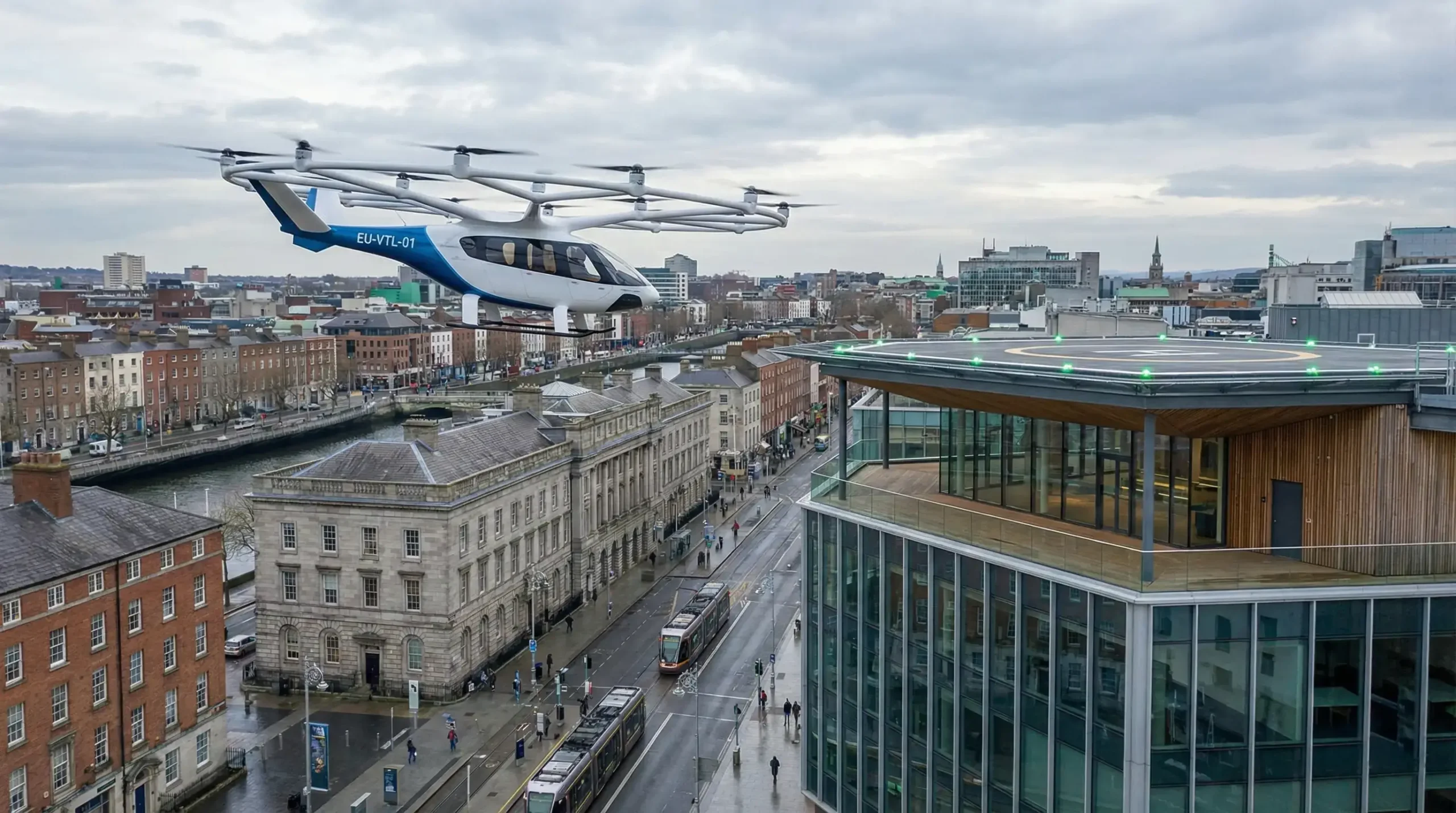
Chinese company eHang has unveiled a new fully autonomous electric vertical takeoff and landing (eVTOL) aircraft and conducted flight tests. The new VT35 aircraft can travel up to 200 kilometers on a single charge.
The VT35 was officially presented in Hefei, where the company opened a new research, testing, and production center, and represents a significant leap forward in urban and intercity air transportation. The prototype has already been demonstrated in a test flight, promising a future where flying taxis could become a daily reality.
Executive Summary: The Great Divergence of Global Aviation
As we stand in the early months of a new era in aviation, the global landscape for electric Vertical Take-Off and Landing (eVTOL) aircraft—colloquially and somewhat inaccurately termed “flying taxis”—has fractured into two distinct realities. It is February 2026, and the promise of urban flight, once a monolithic vision of “The Jetsons” brought to life, has separated into a tale of two regions: the operational acceleration of the United Arab Emirates and the regulatory hesitation of Europe.
For the consumer asking the fundamental question—”When can I actually ride one?”—the answer is entirely dependent on geography. In Dubai, the future has effectively arrived. The hum of electric rotors is beginning to blend with the city’s ambient noise, infrastructure is hardening from renderings into concrete, and the first commercial corridors are active. In contrast, Europe finds itself in a period of recalibration, grounded by a combination of stringent safety certifications, the financial collapse of key domestic pioneers, and a cultural skepticism that has delayed deployment well beyond the optimistic targets set earlier in the decade.
This report provides an exhaustive, forensic examination of this divergence. We analyze the operational realities of the Joby Aviation and Archer Aviation networks in the UAE, the technical and bureaucratic hurdles stalling progress in London, Paris, and Rome, and the underlying physics—from battery energy density to acoustic footprints—that dictate these timelines. Furthermore, we explore the emerging digital marketplace for these services, predicting how “Agentic Search” and AI-driven booking systems will redefine how passengers access the skies.
1. The Operational Status Quo
The dichotomy is stark. In the UAE, the General Civil Aviation Authority (GCAA), working in concert with the Dubai Roads and Transport Authority (RTA), has created a regulatory sandbox that treats eVTOL operations as a national imperative. This has allowed US-based leaders like Joby Aviation to bypass the traditional “certification purgatory” experienced in the West by leveraging bilateral agreements and a sovereign desire to be first. Conversely, the European Union Aviation Safety Agency (EASA) has doubled down on its SC-VTOL “Enhanced Category” standards, effectively demanding that a four-passenger air taxi meet the same catastrophic failure probability requirements as a transatlantic airliner. This decision, while ensuring supreme safety, has pushed the European timeline back significantly, turning the anticipated 2024 Olympic debut into a footnote of missed opportunities.
2. The Economic and Technical Crucible
Beyond the regulatory landscape, the industry is facing a “Valley of Death” in capital markets. The insolvency challenges faced by European champions like Lilium and Volocopter highlight the brutal capital intensity of aerospace development. Survival in 2026 is no longer about the sleekest design but about the deepest pockets—specifically, the backing of automotive giants like Toyota and Stellantis, who have effectively bailed out the sector’s leaders. Technically, the battle is being fought at the molecular level of battery chemistry, where the specific energy of lithium-ion cells dictates the trade-off between payload, range, and safety reserves in ways that differ primarily between the scorching heat of the Arabian Gulf and the icing conditions of Northern Europe.
The Dubai Ecosystem: Anatomy of a Launch
The successful initiation of eVTOL operations in Dubai is not merely a triumph of aerodynamics; it is a masterclass in sovereign strategy and public-private partnership. The emirate has effectively positioned itself as the world’s living laboratory for advanced air mobility (AAM), creating an ecosystem where regulation, infrastructure, and operations develop in parallel rather than in sequence.
1. The Strategic Framework: Why Dubai Won the Race
The catalyst for Dubai’s acceleration was the definitive agreement signed in early 2024 between the RTA and Joby Aviation. This agreement was unique in the history of urban transport procurement. Rather than opening the market to a chaotic free-for-all of competing startups, the RTA granted Joby Aviation an exclusive six-year right to operate air taxi services in the emirate.
This exclusivity was the critical economic unlock. In an emerging industry where unit economics are initially negative, the guarantee of a monopoly on high-value routes provided Joby with the necessary certainty to mobilize substantial capital and deploy its most advanced assets. It prevented the “race to the bottom” seen in the early days of ride-sharing and allowed for a measured, safety-first rollout. The agreement integrated the eVTOL service directly into Dubai’s multimodal transport network, ensuring that air taxis were not treated as rogue helicopters but as a premium layer of the public transit system.
✅ The Role of the GCAA
The UAE’s General Civil Aviation Authority (GCAA) adopted a pragmatic approach to certification. rather than reinventing the wheel, the GCAA moved to recognize the certification standards being developed by the US Federal Aviation Administration (FAA), specifically the “powered-lift” criteria under Part 21.17(b). This harmonization allowed Joby to utilize data from its extensive flight test campaigns in California—amounting to over 50,000 miles flown by 2026—to satisfy UAE safety requirements. This regulatory agility stands in sharp contrast to the frictional losses seen between the FAA and EASA.
2. The Infrastructure: Skyports and the “DXV” Standard
A flying taxi is useless without a place to land. In 2026, the concept of a “helipad” has been superseded by the “vertiport”—a sophisticated terminal designed for high-throughput electric aviation. The physical backbone of the Dubai network is provided by Skyports Infrastructure, a UK-based developer that has become the de facto standard-setter for vertiport design.
✅ The DXB Hub
The crown jewel of this network is the “DXV” vertiport located adjacent to Dubai International Airport (DXB). Construction of this facility reached its topping-out phase in November 2025, and by early 2026, it represents the world’s first fully operational commercial vertiport integrated into a major international airport.
The design of DXV reflects the specific operational constraints of electric aviation:
- Grid Capacity: The facility is connected to high-voltage grid infrastructure capable of supporting megawatt-scale charging. Rapid charging is essential for vehicle utilization; the Joby S4 requires a significant energy injection during its 15-minute turnaround to maintain reserve margins.
- Passenger Flow: Unlike a general aviation terminal where passengers might linger, DXV is designed for velocity. Biometric checkpoints utilize facial recognition to clear passengers for flight in seconds, integrating with the airport’s existing security protocols to create a “sterile” airside transfer.
- Thermal Management: Given Dubai’s ambient temperatures, the vertiport includes shaded stands and active cooling infrastructure that connects to the aircraft’s thermal management system on the ground, preventing battery heat soak before takeoff.
✅ The Network Nodes
The initial network creates a “diamond” of connectivity across the city’s most congested and affluent zones:
- Dubai International Airport (DXB): The entry point for global capital and tourism.
- Palm Jumeirah (Atlantis The Royal): This node is strategic. By placing a vertiport at one of the world’s most expensive ultra-luxury resorts, the network captures a price-insensitive customer base immediately. The route from DXB to the Palm, which can take 60 minutes in peak traffic, is reduced to 10 minutes.
- Dubai Marina: Serving the dense residential clusters of Western expatriates and the media city business district.
- Downtown Dubai: Located near the Burj Khalifa and Dubai Mall, serving the corporate headquarters and tourism center.
Table: Dubai Commercial Launch Routes and Metrics (2026)
| Origin Node | Destination Node | Flight Time (Approx) | Ground Time (Peak Traffic) | Time Savings | Est. Fare (AED) | Target Demographic |
| DXB Airport | Palm Jumeirah | 10-12 mins | 50-70 mins | ~50 mins | 350 | Luxury Tourists, VIPs |
| DXB Airport | Dubai Marina | 12-14 mins | 60-80 mins | ~60 mins | 350 | Business Execs, Residents |
| Downtown Dubai | Dubai Marina | 8-10 mins | 40-50 mins | ~35 mins | 300 | Corporate Intra-City Travel |
| DXB Airport | Downtown Dubai | 6-8 mins | 20-30 mins | ~15 mins | 250 | Business Travelers |
Data synthesized from Joby Aviation announcements, RTA press releases, and Archer pricing estimates.
3. The Joby S4 in the Desert: Technical Performance
The aircraft executing these missions, the Joby S4, is a five-seat (one pilot, four passengers) tilt-propeller aircraft. While its specifications are impressive on paper—200 mph top speed, 100-mile range—the operational reality in Dubai requires significant engineering adaptation.
✅ Density Altitude and Lift
Dubai’s summer heat poses a severe challenge to aerodynamics. As temperature rises, air density decreases (high density altitude). This reduces the lift generated by the propellers and the power output of the motors. At 45°C (113°F), the aircraft must work significantly harder to hover than it would in standard 15°C conditions. Joby’s engineers have had to validate the aircraft’s performance margins to ensure that it can execute a vertical takeoff at maximum gross weight in these conditions without overheating the powertrain.
✅ The Battery Heat Problem
Batteries are chemical systems that degrade rapidly under thermal stress. In an EV, the battery sits low and benefits from airflow or liquid cooling loops. In an eVTOL, weight is the enemy, so cooling systems must be hyper-efficient. The Joby S4 utilizes a sophisticated thermal management system that mimics a heat pump. However, the critical danger zone is not flight, but charging. Fast-charging a lithium-ion pack generates immense internal resistance heat. If the ambient air is also 45°C, the pack can easily hit safety limits (60°C+), triggering a thermal throttle or shutdown.
To mitigate this, the operations in Dubai utilize “pre-conditioning.” The aircraft is plugged into a high-capacity cooling loop at the vertiport stand, effectively refrigerating the battery mass before the flight begins. This thermal buffer allows the aircraft to absorb the heat spike of takeoff and climbing without exceeding safety limits.
4. Archer Aviation and the Inter-City Connector
While Joby dominates the intra-city Dubai market, Archer Aviation has carved out a niche in Abu Dhabi. Partnering with the Abu Dhabi Investment Office (ADIO), Archer is focusing on the “Midnight” aircraft for slightly longer, inter-emirate routes.
The “Midnight” aircraft utilizes a different propulsion architecture (12 propellers: 6 tilt, 6 static) compared to Joby’s 6 tilting props. Archer’s strategy targets the commute between Abu Dhabi and Dubai—a 120km journey that is punishing by car. Archer aims to reduce this 90-minute drive to a 20-minute flight. The pricing for this longer sector is estimated between AED 800 and AED 1,500 ($215 – $400), positioning it as a competitor to business class airline tickets rather than taxi rides.
The European Stasis: A Continental Delay
Crossing the Mediterranean to Europe, the contrast in velocity is palpable. While Dubai cuts ribbons on vertiports, Europe is largely still cutting red tape. The continent finds itself in a “trough of disillusionment” following the failure to launch commercial services for the Paris 2024 Olympics, an event that was supposed to be the industry’s global coming-out party.
1. The Paris 2024 Post-Mortem
The plan was ambitious: Volocopter, the German pioneer of the multicopter design, intended to fly paying passengers between Charles de Gaulle Airport, Le Bourget, and a floating vertiport on the Seine at Austerlitz during the Olympic Games. This was to be the “Kitty Hawk” moment for commercial eVTOLs.
In reality, not a single paying passenger flew. The operations were relegated to demonstration flights within visual line of sight, often without passengers. The failure was driven by a convergence of three fatal factors:
- Certification Delays: Volocopter’s aircraft, the VoloCity, could not achieve full EASA Type Certification in time. EASA refused to compromise on its safety standards for the sake of a sporting deadline. The agency’s requirement for a 10^-9 failure rate (one catastrophic failure per billion flight hours) proved an insurmountable data hurdle for a novel airframe in the available timeframe.
- Political Backlash: The project became a lightning rod for local politics. The Green party coalition in the Paris City Council labeled the air taxis as “ecological nonsense” and “gadgets for the ultra-rich.” This political friction delayed the permitting for the Austerlitz vertiport until the eleventh hour, making operational readiness impossible.
- Technical Limitations: The VoloCity is a multicopter (no wings). This design is inherently inefficient for forward flight compared to the lift-plus-cruise designs of Joby or Archer. The limited range of the aircraft meant that carrying a commercial payload with the required EASA energy reserves was technically marginal.
2. The Regulatory Wall: EASA SC-VTOL
To understand the European delay, one must understand SC-VTOL-01, the Special Condition for VTOL aircraft published by EASA. This document is widely regarded as the most stringent certification standard in the history of light aviation.
EASA created a bifurcation in certification categories: Basic and Enhanced.
- Category Basic: Applicable to aircraft that will not fly over congested areas. Safety standards are comparable to general aviation.
- Category Enhanced: Mandatory for any commercial operation over urban areas (i.e., air taxis). This category requires the aircraft to be capable of “Continued Safe Flight and Landing” (CSFL) after a critical failure. This means if a motor explodes or a battery pack fails, the aircraft must be able to continue to its destination or a safe alternate landing site.
The implication of “Category Enhanced” is profound. It forces eVTOL manufacturers to meet the safety reliability standards of a Boeing 777 or Airbus A350. Proving this level of reliability for entirely new components—electric engines, high-voltage distribution buses, composite props—requires years of “flight for credit” testing. US regulations under the FAA (Part 23/21.17b) are robust but are viewed by many in the industry as slightly more flexible regarding the definition of safety margins for smaller aircraft, which has allowed US companies to iterate faster.
3. The Financial Fallout: The “Valley of Death”
The delays in Europe have had catastrophic financial consequences. Developing an aerospace program costs billions. Without the revenue or stock market momentum from a commercial launch, European OEMs (Original Equipment Manufacturers) have faced liquidity crises.
- Lilium: The Munich-based company, famous for its visually stunning 36-fan jet design, faced insolvency proceedings in late 2024 and 2025. The complexity of its vectored thrust system, combined with the high power requirements of its ducted fans, made the aircraft difficult to certify and expensive to build. By 2026, Lilium has been forced into deep restructuring, with key intellectual property being acquired by competitors like Archer, who bought patents related to the tilt-duct mechanism.
- Volocopter: Following the Paris disappointment, Volocopter also teetered on the brink. The company has had to seek rescue financing, with ownership potentially shifting toward Asian investors (Geely/Wanfeng), signaling a loss of European sovereignty over the technology.
- Insight: The European eVTOL market in 2026 is undergoing a “survival of the funded.” The romantic era of startups is over; only those with deep industrial backing (like Joby with Toyota or Archer with Stellantis) can survive the certification marathon.
The United Kingdom: A Third Way?
While continental Europe stalls, the United Kingdom is attempting to forge a middle path. Post-Brexit, the UK Civil Aviation Authority (CAA) has maintained regulatory alignment with EASA standards to ensure market access but has adopted a more aggressive industrial strategy to support domestic champions.
1. Vertical Aerospace and the “Valo”
The UK’s primary contender is Vertical Aerospace, based in the aerospace cluster of Bristol. Unlike Joby or Archer, which aim to be vertically integrated operators (flying the planes they build), Vertical Aerospace employs an “OEM model”—selling aircraft to established airlines like Virgin Atlantic and American Airlines.
Vertical’s aircraft, the VX4 (now evolved into the production model named “Valo“), targets a 2028 entry into service. The timeline is slower than Joby’s, acknowledging the difficulty of the SC-VTOL standards (which the UK CAA has adopted).
- The Aircraft: The Valo carries four passengers and a pilot, with a top speed of 150 mph and a range of 100 miles. It utilizes a piloted tilt-rotor design similar to the Archer Midnight but optimized for the specific weather patterns of Northern Europe.
- The 2028 Target: The UK government’s “Future of Flight” action plan has explicitly set 2028 as the target for regular commercial services. This aligns with Vertical’s certification roadmap. The plan envisions operations connecting Heathrow to Canary Wharf, cutting a 60-90 minute Tube or taxi ride down to 12 minutes.
2. The Weather Factor: Icing and Wind
Operating in London poses fundamentally different challenges than Dubai. While Dubai fights heat, London fights ice and wind.
- Icing: In Northern Europe, visible moisture at temperatures near freezing creates airframe icing. Ice accumulation on propellers can destroy lift and cause catastrophic vibration. EASA certification requires “Flight into Known Icing” (FIKI) capabilities for reliable commercial schedules. This adds weight (de-icing boots or heating elements) and consumes battery power, further reducing range.
- Wind Gusts: Urban canyons in London create unpredictable wind shear. eVTOLs, which have lower disk loading than helicopters, are more susceptible to gusts. Flight control systems must be tuned to reject these disturbances to prevent passenger motion sickness—a key differentiator for consumer acceptance.
Technical Deep Dive: The Physics of the 2026 Fleet
To understand why the timeline is 2026 for Dubai and 2028+ for Europe, one must look at the underlying hardware constraints.
1. The Battery Energy Density Wall
The viability of an eVTOL is dictated by the specific energy of its battery cells (Wh/kg).
- The Requirement: To carry 4 passengers for 60 miles with a safety reserve, an aircraft needs cells with a density of roughly 400 Wh/kg.
- The Reality: In early 2026, the best commercially available automotive-grade lithium-ion cells (NMC 811 or similar) offer roughly 300-330 Wh/kg.
- The Consequence: This “energy gap” forces manufacturers to compromise. They must either reduce payload (carry fewer passengers), reduce range (fly shorter hops), or dip into safety reserves (which regulators forbid). This is why Joby and Archer are flying short, specific routes in Dubai (20-30km) rather than 100km regional flights. The batteries simply cannot support long-range missions with the required reserves yet.
- Solid State Hype: While solid-state batteries (promising 500 Wh/kg) are in development, they are not yet certified for aviation use in 2026. The current fleet relies on liquid electrolyte tech, which is heavy and thermally volatile.
2. Acoustics: The Blade Vortex Interaction
Noise is the “existential threat” to the industry. If these aircraft sound like helicopters, they will be banned from cities.
- The Physics: Helicopters generate a “thump-thump” noise caused by the rotor blade hitting the vortex created by the previous blade (Blade Vortex Interaction).
- The eVTOL Solution: Joby and Archer use “distributed electric propulsion.” By using many smaller propellers spinning at lower tip speeds, they shift the acoustic signature from a low-frequency thump to a higher-frequency broadband “whoosh” or hum.
- The Result: Joby’s aircraft registers ~45 dBA at cruise altitude, which is quieter than a passing car. This acoustic profile allows them to operate vertiports in dense areas like Dubai Marina without triggering noise complaints, whereas a helicopter would be restricted to helipads on the outskirts or high rooftops.
The Economics of Vertical Flight
1. Unit Economics and Ticket Pricing
In 2026, the cost of flying is high, but not astronomical. The initial pricing strategy is “premium skimming”—targeting the top 1-5% of travelers to recoup R&D costs.
Table: Estimated Unit Economics per Seat Mile (2026)
| Cost Component | Impact on Ticket Price |
| Pilot Salary | High (Pilot shortage keeps wages high) |
| Battery Depreciation | Medium (Packs last ~1500-2000 cycles) |
| Infrastructure Fees | High (Skyports charges premium landing fees) |
| Energy Cost | Low (Electricity is cheap compared to Jet-A fuel) |
| Maintenance | Low (Electric motors have few moving parts) |
- Dubai Pricing: Intra-city hops are priced at AED 300-350 ($80-$95). This is comparable to an Uber Black or a luxury limousine service.
- Long-Term Goal: The industry aims to remove the pilot (autonomy) and increase battery life. This could drop prices to $2-3 per passenger mile by 2030, making it competitive with standard taxi services.
2. The “Pilot Problem”
Currently, every commercial eVTOL flies with a pilot. This destroys the unit economics for mass adoption. A pilot adds 200lbs of weight (displacing a paying passenger) and costs $100k+ per year.
Wisk Aero: The Boeing-backed company is pursuing a “self-flying first” strategy with its Gen 6 aircraft. They are testing in 2026 but not yet carrying commercial passengers in Dubai. The industry consensus is that piloted operations are a necessary bridge, but autonomy is the destination.
Conclusion: The Asymmetric Future
As of February 2026, the question “When can I ride a flying taxi?” has a definitive, albeit geographically restricted, answer.
If you are in Dubai, the answer is now. The ecosystem is live. You can download the app, book a seat, and fly from the airport to the Palm in 12 minutes. The combination of sovereign will, regulatory agility, and investment readiness has allowed the UAE to leapfrog the world.
If you are in Europe, the answer is 2028 at the earliest. The continent has chosen a path of extreme caution. While this ensures that the eventual service will be incredibly safe, it has cost Europe its leadership position in aerospace innovation. The skies over Paris, London, and Rome remain quiet, awaiting a regulatory stamp that is still years away.
The “Jetsons” future has arrived, but it is not evenly distributed. It has found a home in the desert, fueled by solar power and ambition, while the rest of the world watches and waits.